
Proof of Competency Laws for Boaters in Canada
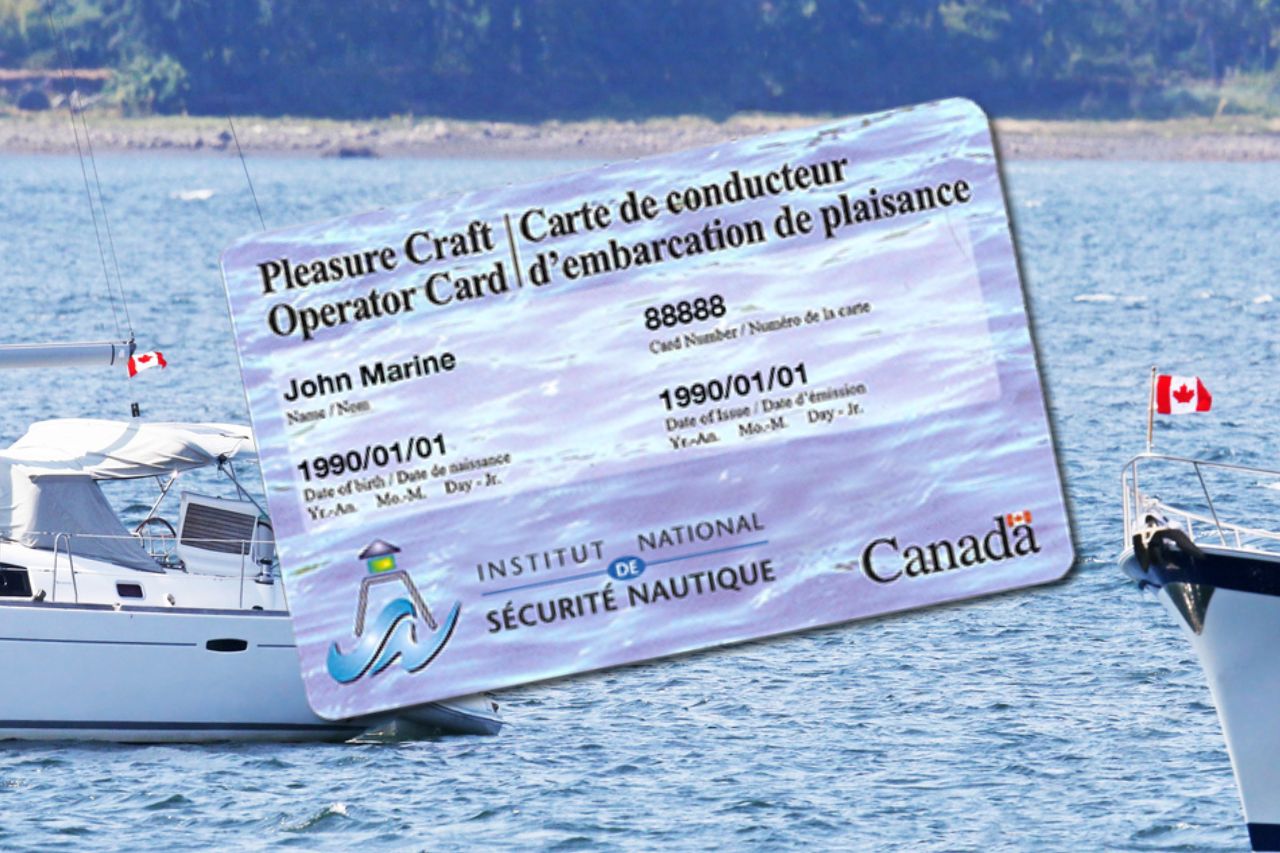
According to the Competency of Operators of Pleasure Craft Regulations (SOR/99-53), all boaters who are operating a motorized pleasure craft for recreational purposes on Canadian waters require proof of competency. This applies even if the boat’s motor is turned off.
Key takeaways
- You are legally required to have Transport Canada approved proof of competency when operating a motorised boat on Canadian waters.
- Exceptions apply for foreign boaters (within a time limit), boaters in the Northwest Territories and Nunavut, in the case of seaplanes, and for Indigenous Peoples engaged in subsistence activities.
Table of contents
- A Brief History of Proof of Competency for Boaters in Canada
- Types and formats of proof of competency for Canadian boaters
- Pleasure Craft Operator Card (PCOC)
- Boat Rental Safety Checklist
- Certificate from a Canadian boating safety course completed before April 1, 1999
- Professional marine certificate or equivalent
- Foreign documentation
- Obtaining proof of competency legally within Canada
- Frequently Asked Questions
A Brief History of Proof of Competency for Boaters in Canada
- Before 1999, anyone could operate a boat in Canada without passing a test or getting certified.
- That year, due to rising concern about boating-related injuries and deaths, Transport Canada launched the National Pleasure Craft Operator Competency Program.
- At first, proof of competency was only required for those born after April 1, 1983.
- By 2009, all motorized boat operators in Canada were required to have proof of competency.
- Transport Canada continued to develop and maintain the regulations and standards related to proof of competency for recreational boaters. This included verifying safe boating courses available to the public, by which boat operators can learn what they need to know to pass a Transport Canada approved exam and prove their knowledge of boating safety.
- Today, all motorized boat operators in all provinces and territories of Canada need proof of competency in the form of a Pleasure Craft Operator Card or verified boat rental checklist in order to operate a motorized vessel for recreational purposes.
Types and formats of proof of competency for Canadian boaters
For recreational boating in Canada, legal proof of competency can be presented in several formats:
1. Pleasure Craft Operator Card (PCOC)
The most common and widely-used format is the permanent Pleasure Craft Operator Card (PCOC). A paper or electronic copy of a PCOC is not considered valid by law enforcement.
2. Boat Rental Safety Checklist
If you are renting a boat, a completed Rental Boat Safety Checklist serves as proof of competency for the duration of the rental period.
3. Certificate from a Canadian boating safety course completed before April 1, 1999
If you completed a reputable Canadian boating safety course before April 1, 1999, when the proof of competency rules came into effect, your certificate of completion will be considered adequate.
4. Professional marine certificate or equivalent
A professional marine certificate or equivalent from the List of Certificates of Competency, Training Certificates and other Equivalencies accepted as Proof of Competency when Operating a Pleasure Craft certifies you to operate a motorized pleasure craft anywhere in Canada.
5. Foreign documentation
For a visitor to Canada, the proof of competency regulations only apply if you operate your pleasure craft in Canadian waters for more than 45 consecutive days or if you are operating a pleasure craft that is licensed or registered in Canada.
In these situations, you must have one of the following:
- A Pleasure Craft Operator Card
- A completed boat rental safety checklist OR
- An operator card or other document that meets the requirements of your home state or country
Obtaining proof of competency legally within Canada
To get your PCOC, you must follow a boating safety course that is accredited by Transport Canada, then pass an exam.
Age restrictions for obtaining proof of competency
There is no age limit to obtaining proof of competency, however some restrictions to vessel operation do apply:
- Unsupervised operators under age 12 can only operate a vessel powered by 10hp (7.5 kw) or less.
- Unsupervised operators between 12 and 16 years old can only operate a vessel powered by 40hp (30kw) or less.
- Persons younger than 16 years old cannot operate a PWC.
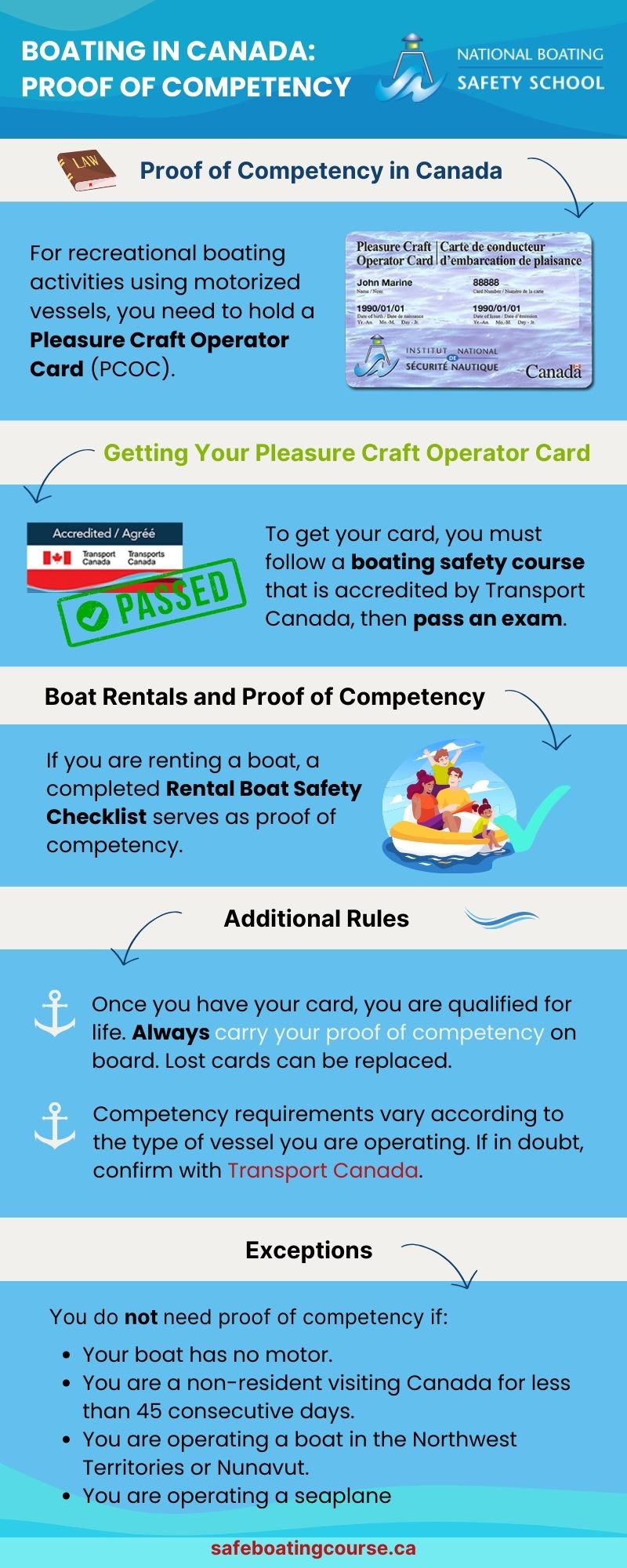
The National Boating Safety School safe boating course will prepare you to obtain your Pleasure Craft Operator Card
The National Boating Safety School offers a Transport Canada approved boating safety course that will prepare you for the official online boating exam. Once you pass the test, you will be awarded your lifetime Pleasure Craft Operator Card. Register today!
Frequently Asked Questions
1. Are there exceptions to the proof of competency requirements for boaters in Canada?
Generally, if you are a non-resident operating your foreign-licensed pleasure craft in Canadian waters for less than 45 consecutive days, you are not required to have a Canadian Pleasure Craft Operator Card (PCOC). In this case, your foreign operator card or equivalent from your home country or state should be sufficient, and you must carry proof of residence on board at all times.
You do not need proof of competency to operate a pleasure craft on Canadian waters if you are operating a boat in the Northwest Territories or Nunavut, or you are operating a seaplane (other qualifications apply).
Indigenous Peoples who use a motorized pleasure craft for subsistence activities are also exempt.
2. Is proof of competency required for non-motorised vessels?
You do not need proof of competency to operate a non-motorized boat on Canadian waters.
3. Can my proof of competency expire?
Once you have your card, you are qualified for life. Always carry your proof of competency on board.
4. What if I lose my proof of competency?
The National Boating Safety School can replace lost or damaged cards issued by any other organisation. If you have trouble contacting the course provider, you can get help by calling the Boating Safety Infoline at 1-800-267-6687.
5. Are there different types of proof of competency for different types of boats?
Yes, competency requirements may vary according to the type of vessel you are operating. If you are operating a vessel for commercial purposes (e.g., carrying paying passengers, commercial fishing, or other work-related activities), a PCOC is not sufficient. You will need to obtain specific commercial marine safety certifications from Transport Canada, which are much more extensive and vary depending on the vessel's size, type, and intended use. Examples include the Small Vessel Operator Proficiency (SVOP) certification and various Master or Mate certificates.
6. Who enforces proof of competency for boaters in Canada?
Enforcement of boating proof of competency for boaters in Canada is carried out by:
- Royal Canadian Mounted Police (RCMP)
- Provincial police forces
- Municipal police forces
- Other local authorities, including conservation officers and park wardens
7. Do I need proof of competency to go boating in a Canadian national park?
Yes, if you're operating a motorized pleasure craft in a Canadian National Park, you need proof of competency. While National Parks have their own specific regulations (especially regarding aquatic invasive species, motor types, and access to certain water bodies), the general federal boating regulations under Transport Canada still apply.
8. Do I need proof of competency to go boating on a river or lake in Canada?
Transport Canada's Competency of Operators of Pleasure Craft Regulations apply to boaters on rivers, lakes, and coastal areas.
9. Do I need proof of competency if my boat has an electric motor?
Yes, if your boat has any type of motor (including electric trolling motors), even if it is not in use, you need proof of competency to operate it legally.
10. Can I get my proof of competency in Canada while living in another country?
Yes. Transport Canada has no residency requirement for obtaining a PCOC. Many of the accredited course providers, including the National Boating Safety School, offer their entire course and exam online.
Sources
- Transport Canada. (2017, April) RENTAL BOAT SAFETY CHECKLIST. . https://tc.canada.ca/sites/default/files/migrated/eng_checklist_houseboat_final.pdf
- Government of Canada (current to 2025-06-25) Competency of Operators of Pleasure Craft Regulations. SOR/99-53. Justice Laws Website. https://laws.justice.gc.ca/eng/regulations/SOR-99-53/page-1.html
- Government of Canada. Pleasure Craft Operator Card (PCOC). Transport Canada. https://tc.canada.ca/en/marine-transportation/preparing-operate-your-vessel/pleasure-craft-operator-card-pcoc
- Government of Canada. List of Certificates of Competency, Training Certificates and other Equivalencies accepted as Proof of Competency when Operating a Pleasure Craft. Transport Canada. https://tc.canada.ca/en/marine-transportation/marine-safety/list-certificates-competency-training-certificates-other-equivalencies-accepted-proof-competency-when-operating-pleasure-craft
- Government of Canada. Visitor Information. Transport Canada. https://tc.canada.ca/en/marine-transportation/preparing-operate-your-vessel/visitor-information
- Government of Canada. Law enforcement at Parks Canada. Parks Canada. https://parks.canada.ca/agence-agency/loi-law
Related CONTENT
LAtest ARTICLES
"citation": [
{
"@type": "WebPage",
"name": "Transport Canada. (2017, April) RENTAL BOAT SAFETY CHECKLIST. ",
"url": "https://tc.canada.ca/sites/default/files/migrated/eng_checklist_houseboat_final.pdf"
},
{
"@type": "WebPage",
"name": "Government of Canada (current to 2025-06-25) Competency of Operators of Pleasure Craft Regulations. SOR/99-53. Justice Laws Website",
"url": "https://tc.canada.ca/en/marine-transportation/marine-safety/compliance-notices-pleasure-non-pleasure-craft"
},
{
"@type": "WebPage",
"name": "Government of Canada. Pleasure Craft Operator Card (PCOC). Transport Canada",
"url": "https://tc.canada.ca/en/marine-transportation/preparing-operate-your-vessel/pleasure-craft-operator-card-pcoc"
},
{
"@type": "WebPage",
"name": "Government of Canada. List of Certificates of Competency, Training Certificates and other Equivalencies accepted as Proof of Competency when Operating a Pleasure Craft. Transport Canada",
"url": "https://tc.canada.ca/en/marine-transportation/marine-safety/list-certificates-competency-training-certificates-other-equivalencies-accepted-proof-competency-when-operating-pleasure-craft"
},
{
"@type": "WebPage",
"name": "Government of Canada. Visitor Information. Transport Canada",
"url": "https://tc.canada.ca/en/marine-transportation/preparing-operate-your-vessel/visitor-information"
},
{
"@type": "WebPage",
"name": "Government of Canada. Law enforcement at Parks Canada. Parks Canada",
"url": "https://parks.canada.ca/agence-agency/loi-law"
}
]
},
{
"@type": "ItemList",
"name": "Key takeaways",
"itemListElement": [
{
"@type": "ListItem",
"position": 1,
"name": "You are legally required to have Transport Canada approved proof of competency when operating a motorised boat on Canadian waters."
},
{
"@type": "ListItem",
"position": 2,
"name": "Exceptions apply for foreign boaters (within a time limit), boaters in the Northwest Territories and Nunavut, in the case of seaplanes, and for Indigenous Peoples engaged in subsistence activities."
}
]
},
{
"@type": "ItemList",
"name": "Table of contents",
"itemListElement": [
{
"@type": "ListItem",
"position": 1,
"name": "A Brief History of Proof of Competency for Boaters in Canada"
},
{
"@type": "ListItem",
"position": 2,
"name": "Types and formats of proof of competency for Canadian boaters"
},
{
"@type": "ListItem",
"position": 3,
"name": "Pleasure Craft Operator Card (PCOC)"
},
{
"@type": "ListItem",
"position": 4,
"name": "Boat Rental Safety Checklist"
},
{
"@type": "ListItem",
"position": 5,
"name": "Certificate from a Canadian boating safety course completed before April 1, 1999"
},
{
"@type": "ListItem",
"position": 6,
"name": "Professional marine certificate or equivalent"
},
{
"@type": "ListItem",
"position": 7,
"name": "Foreign documentation"
},
{
"@type": "ListItem",
"position": 8,
"name": "Obtaining proof of competency legally within Canada"
},
{
"@type": "ListItem",
"position": 9,
"name": "Age restrictions for obtaining proof of competency"
},
{
"@type": "ListItem",
"position": 10,
"name": "Frequently Asked Questions"
}
]
},
{
"@type": "ItemList",
"name": "Related contents",
"itemListElement": [
{
"@type": "ListItem",
"position": 1,
"url": "https://safeboatingcourse.ca/law/",
"name": "Canada Boating Regulations and Laws"
},
{
"@type": "ListItem",
"position": 2,
"url": "https://safeboatingcourse.ca/boat-compliance-notice/",
"name": "Boat Compliance Notices: Everything You Need to Know"
},
{
"@type": "ListItem",
"position": 3,
"url": "https://safeboatingcourse.ca/hull-identification-number/",
"name": "Hull Identification Numbers (HIN) Explained"
}
]
},
{
"@type": "FAQPage",
"mainEntity": [
{
"@type": "Question",
"name": "Are there exceptions to the proof of competency requirements for boaters in Canada?",
"acceptedAnswer": {
"@type": "Answer",
"text": "Generally, if you are a non-resident operating your foreign-licensed pleasure craft in Canadian waters for less than 45 consecutive days, you are not required to have a Canadian Pleasure Craft Operator Card (PCOC). In this case, your foreign operator card or equivalent from your home country or state should be sufficient, and you must carry proof of residence on board at all times. You do not need proof of competency to operate a pleasure craft on Canadian waters if you are operating a boat in the Northwest Territories or Nunavut, or you are operating a seaplane (other qualifications apply). Indigenous Peoples who use a motorized pleasure craft for subsistence activities are also exempt."
}
},
{
"@type": "Question",
"name": "Is proof of competency required for non-motorised vessels?",
"acceptedAnswer": {
"@type": "Answer",
"text": "You do not need proof of competency to operate a non-motorized boat on Canadian waters."
}
},
{
"@type": "Question",
"name": "Can my proof of competency expire?",
"acceptedAnswer": {
"@type": "Answer",
"text": "Once you have your card, you are qualified for life. Always carry your proof of competency on board."
}
},
{
"@type": "Question",
"name": "What if I lose my proof of competency?",
"acceptedAnswer": {
"@type": "Answer",
"text": "The National Boating Safety School can replace lost or damaged cards issued by any other organisation. If you have trouble contacting the course provider, you can get help by calling the Boating Safety Infoline at 1-800-267-6687."
}
},
{
"@type": "Question",
"name": "Are there different types of proof of competency for different types of boats?",
"acceptedAnswer": {
"@type": "Answer",
"text": "Yes, competency requirements may vary according to the type of vessel you are operating. If you are operating a vessel for commercial purposes (e.g., carrying paying passengers, commercial fishing, or other work-related activities), a PCOC is not sufficient. You will need to obtain specific commercial marine safety certifications from Transport Canada, which are much more extensive and vary depending on the vessel's size, type, and intended use. Examples include the Small Vessel Operator Proficiency (SVOP) certification and various Master or Mate certificates."
}
},
{
"@type": "Question",
"name": "Who enforces proof of competency for boaters in Canada?",
"acceptedAnswer": {
"@type": "Answer",
"text": "Enforcement of boating proof of competency for boaters in Canada is carried out by: Royal Canadian Mounted Police (RCMP), provincial police forces, municipal police forces, and other local authorities, including conservation officers and park wardens. These officers have the authority to stop, board, and inspect pleasure crafts and you are required to present your proof of competency at their request."
}
},
{
"@type": "Question",
"name": "Do I need proof of competency to go boating in a Canadian national park?",
"acceptedAnswer": {
"@type": "Answer",
"text": "Yes, if you're operating a motorized pleasure craft in a Canadian National Park, you need proof of competency. While National Parks have their own specific regulations (especially regarding aquatic invasive species, motor types, and access to certain water bodies), the general federal boating regulations under Transport Canada still apply."
}
},
{
"@type": "Question",
"name": "Do I need proof of competency to go boating on a river or lake in Canada?",
"acceptedAnswer": {
"@type": "Answer",
"text": "Transport Canada's Competency of Operators of Pleasure Craft Regulations apply to boaters on rivers, lakes, and coastal areas."
}
},
{
"@type": "Question",
"name": "Do I need proof of competency if my boat has an electric motor?",
"acceptedAnswer": {
"@type": "Answer",
"text": "Yes, if your boat has any type of motor (including electric trolling motors), even if it is not in use, you need proof of competency to operate it legally."
}
},
{
"@type": "Question",
"name": "Can I get my proof of competency in Canada while living in another country?",
"acceptedAnswer": {
"@type": "Answer",
"text": "Yes. Transport Canada has no residency requirement for obtaining a PCOC. Many of the accredited course providers, including the National Boating Safety School, offer their entire course and exam online."
}
}
]
}
]
}