Boat Compliance Notices in Canada: Rules and Regulations

A compliance notice is a sticker, metal label or plate issued by a boat manufacturer or importer. It certifies that a vessel meets the standards set out in the Government of Canada’s Small Vessel Regulations.
Key takeaways
- A compliance notice is an official label that proves a vessel meets Canadian construction standards for its proposed use.
- Most motorised vessels are legally required to have a compliance notice, however some exceptions apply, including homemade boats and vessels built before April 29, 2010.
- There are two main types of compliance notices: those intended for pleasure craft under 24 metres in length, and those intended for vessels over 24 metres in length (in which case they will be labeled differently depending on whether they will be used as pleasure craft or non-pleasure craft).
Table of contents
- Purpose of a compliance notice
- Types of boats that require a Canadian compliance notice
- Types of boats that are exempt from requiring a compliance notice
- Persons responsible for issuing compliance notices in Canada
- Where to find the compliance notice on your boat
- Information included on a compliance notice
- Types of Compliance Notices
- Frequently Asked Questions
Purpose of a compliance notice
A boat compliance notice certifies that a boat complies with up-to-date safety, performance and environmental regulations. It was formerly called a Canadian Capacity Plate / Label.
A compliance notice is typically required to operate any motorised vessel and may also be necessary to participate in specific events. For example, you may need one as proof that your boat complies with the safety rules of a regatta or boating competition.
Types of boats that require a Canadian compliance notice
In Canada, most pleasure craft less than 24 meters in length that are, or can be, fitted with a motor, need a compliance notice. Vessels over 24 metres need a special compliance notice, known as a “conformity label”, that indicates whether they are built to pleasure craft or commercial vessel standards.
Types of boats that are exempt from requiring a compliance notice
Exceptions include:
- Vessels built for personal use (not for sale)
- Certain older vessels (before April 29, 2010, the manufacturer/importer wasn't required to provide one)
- High-powered vessels used exclusively for racing
- Tugs
- Vessels that are in open construction
- Vessels that are not mass produced
- Vessels that are not propelled or designed to be propelled by an in-board or stern drive engine
- Vessels that have been built based on traditional methods that have been proven safe over the years
Persons responsible for issuing compliance notices in Canada
Manufacturers and importers are responsible for creating and attaching compliance notices to motorized vessels destined for sale or resale in Canada. Dealers and boat owners must verify that their boats are labelled correctly.
Where to find the compliance notice on your boat
A boat compliance notice must be permanently attached in a location that can be seen from the boat’s helm.
Information included on a compliance notice
A compliance notice contains basic information about the boat, safety standards to which it conforms, and possibly also other related safety and navigation certificates.
Basic information found on a compliance notice
- Vessel model
- Name of the builder, manufacturer, rebuilder, or importer
- Statement confirming compliance with construction requirements when it was built or imported (whichever date is most recent)
- Maximum gross load capacity, meaning total weight of persons, fuel and equipment (vessels 6 meters or less in length) also known as a "capacity label"
- Maximum number of persons the vessel can carry (vessels 6 meters or less in length)
- Maximum recommended engine horsepower (vessels 6 meters or less in length).
Other information that can be included on a compliance notice
- Construction, safety, performance, environmental or other international standards
- Technical inspection information or information on safety equipment and navigation systems
- Information about specific safety and navigation certificates: their date of issue, validity date, name of the maritime authority that issued the certificate, etc.
- Design limitations, if any.
Types of Compliance Notices
Compliance notices fall under two categories:
1. Compliance notices for boats under 6 meters
You will need a “compliance notice for boats under 6 metres” if your boat is designed for motorized propulsion and measures less than 6 metres (19′ 8″).
Also known as a “capacity label”, this notice sets safety limits related to load capacity, the number of people on board and engine power.
This type of compliance notice must also include a certificate stating that your boat complies with the construction requirements in effect on the date of construction or importation of the boat.
2. Compliance notice for boats over 6 meters
If your boat is longer than 6 metres, its compliance notice must indicate whether it meets pleasure craft or non-pleasure craft construction requirements.
If the vessel is declared suitable for use as a pleasure craft, it will be issued a “compliance label”, which prevents it from being used for anything other than recreational purposes.
Your boat may be certified for other types of use, and labeled accordingly, if it has been modified to meet these additional requirements:
- Stability assessment
- Requirements for auxiliary machinery
- Additional fire protection
Examples of what a compliance notice looks like
A compliance notice must follow the format and specifications defined by Transport Canada. Please refer to the examples below:
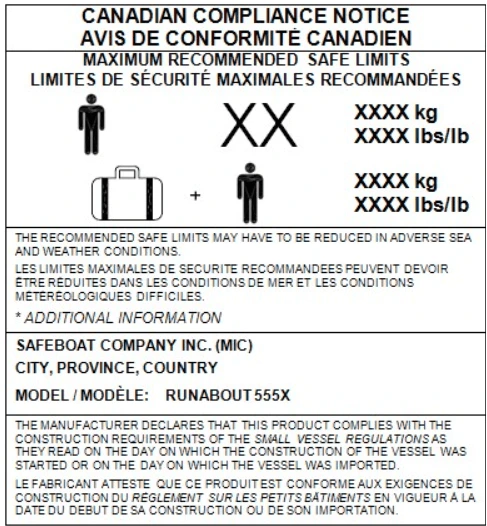
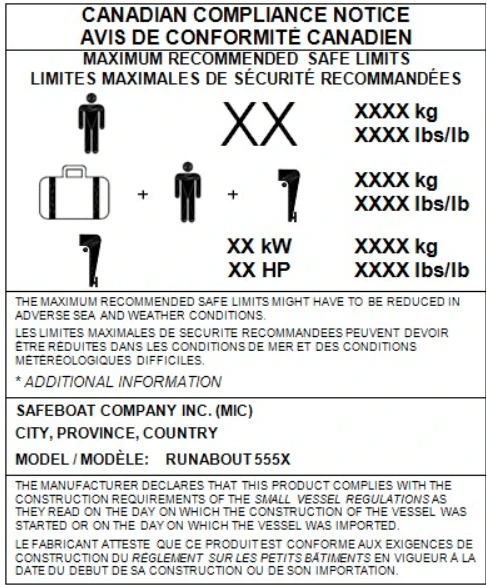
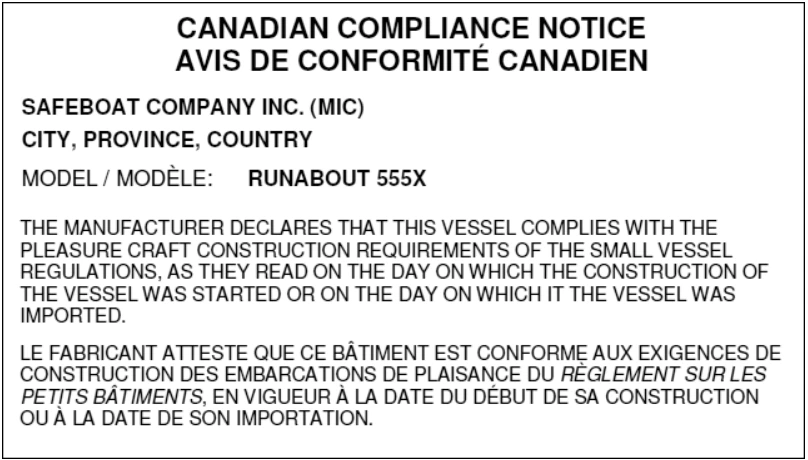
The National Boating Safety School safe boating course will prepare you to obtain your Pleasure Craft Operator Card
The National Boating Safety School offers a Transport Canada approved boating safety course that will prepare you for the official online boating exam. Once you pass the test, you will be awarded your lifetime Pleasure Craft Operator Card. Register today!
Frequently Asked Questions
1. Why do I need a compliance notice?
Canadian boat owners need a compliance notice to prove that their motorised vessel is safe and built to specific standards.
2. Can I remove or alter a compliance notice?
No. It is illegal to remove or alter a compliance notice, or to affix one with incorrect information, and you could be fined. However, if your notice becomes illegible or needs to be removed for repairs, an owner can replace it with a new one containing the same information.
3. What are the consequences of not having a compliance notice?
Not having a compliance notice implies a vessel may not meet safety standards. However, you will not be fined for operating a boat without one, as it is the manufacturer’s responsibility to provide it.
4. What should I do if my boat does not have a compliance notice?
If your boat was built before April 29, 2010, it does not need a compliance notice. Boats built after this date must have a compliance notice, and the owner can contact the manufacturer to request one.
5. Does a compliance notice from another country count in Canada?
You can have compliance notices from other countries on your boat, as long as it also has a Canadian compliance notice.
6. Is a compliance label the only label I need on my boat?
Personal watercraft built after April 29, 2010, according to ISO 13590 Small Craft - Personal Watercraft - Construction and System Installation Requirements must also have an ISO 13590 builder’s plate. Boats built or imported into Canada after August 1, 1981 must show a Hull Identification Number (HIN).
Sources
- Government of Canada (2010, July 6) Compliance notices for pleasure and non-pleasure craft. Transport Canada. https://tc.canada.ca/en/marine-transportation/marine-safety/compliance-notices-pleasure-non-pleasure-craft
- National Boating Safety School. (2011, August 10) COURSE MANUAL TO OBTAIN THE PLEASURE CRAFT OPERATOR CARD. . Manuel Boating Exam En (PDF)
Related CONTENT
LAtest ARTICLES