Guide to Collision Regulations in Canada for Boaters

There are many laws, regulations and codes pleasure craft operators must follow in order to minimize the risk of boating accidents, including the Collision Regulations. Any boater who violates one or more of these regulations will face penalties and/or fines.
Since the Collision Regulations laid out by the Canadian Government’s Department of Justice are fairly lengthy and complex, our boating safety specialists have prepared an overview of the most important points to remember.
Key takeaways
- The Collision Regulations describe important navigation rules for all boaters operating motorised vessels on Canadian waterways.
- The Collision Regulations apply to boating in good weather, however there are also some guidelines for boating in poor visibility.
- Boaters are responsible for maintaining a lookout, yielding to larger vessels, giving non-motorised vessels right of way, and following all rules surrounding crossing and overtaking other boats.
- Following the rules requires a firm grasp of the concept of port and starboard, and the difference between a stand-on and a give-way vessel.
- All boaters are responsible for avoiding collisions, whether by following the rules or taking appropriate evasive action.
Table of contents
- Collision Regulations of Canada: Definition and Scope
- Preventing the spread of invasive species (AIS) while boating
- General Collision Regulations applying to recreational boating in good weather conditions
- 1. Maintain a look-out at all times
- 2. When navigating narrow channels, keep to starboard
- 3. Yield to larger vessels
- 4. Keep your distance from vessels with limited maneuverability
- 5. Be familiar with navigation signals and sounds, and obey them
- 6. Give a clear signal when changing course
- 7. Operate your vessel at safe speeds
- 8. Avoid reckless or dangerous manoeuvres
- Collision Regulations applying to recreational boating in poor weather conditions
- Boating right-of-way rules: avoiding collisions when passing or crossing another boat
- Frequently Asked Questions
Collision Regulations of Canada: Definition and Scope
The Collision Regulations establish standards and procedures for boating on Canada’s waterways. The purpose of the regulations is to reduce the likelihood of collisions. They apply to all vessels, from small pleasure crafts to cargo ships.
The Collision Regulations outline the responsibilities of vessels underway and determine who has right of way when two boats are in an overtaking, crossing or head-on situation.
General Collision Regulations applying to recreational boating in good weather conditions
Once underway, all operators of motorised pleasure craft must follow the rules outlined in the Collision Regulations. Here are a few of the most important:
1. Maintain a look-out at all times
The Collision Regulations require every vessel to maintain a look-out at all times to help anticipate collision risks.
As the operator of a pleasure craft, you need to remain alert for visual and auditory cues (other boats may use sound signals) from any direction. You are not allowed to put your boat on autopilot and leave your post.
You are required to use all resources at your disposal (including radar and radio if applicable) to determine whether there is any risk of collision with another boat.
You should also familiarize yourself with the regulations in effect on the waterways you are planning to use (i.e. American regulations for U.S. waters). Following the rules starts before you even get underway!
2. When navigating narrow channels, keep to starboard
According to the Collision Regulations, vessels navigating a narrow channel or fairway must keep close to the edge that is on their starboard side, provided that it is safe and practical to do so.
3. Yield to larger vessels
When navigating near large vessels, it’s important to remember that their size can make them more difficult to maneuver. It also takes longer for them to come to a full stop. For that reason, vessels under 20 m (65’7”) long and sailing ships must yield to large vessels.
Remember, large vessels often can’t see you until it’s too late.
It is your responsibility as a boat operator to:
- Remain vigilant and be ready to yield to large vessels safely, taking weather and water conditions into account
- Use radar and radio if your boat has them
- Improve your small craft’s visibility by travelling in a group
- Never cross between a tug and its tow
- Never cross a shipping lane
- Never attempt to cross in front of a larger vessel
- Avoid docked ferries, ferries in transit and working fishing vessels.
4. Keep your distance from vessels with limited maneuverability
Power-driven vessels must stay out of the way of sailboats, fishing boats, rowboats and any other vessels with limited maneuverability.
5. Be familiar with navigation signals and sounds, and obey them
Canadian pleasure craft operators are responsible for using both visual and sound signals correctly and responsibly. This includes boating distress signals as well as warning signals like diving flags. Different navigation lights are required on most motorised boats (depending on their size) and failure to display them could result in fines. If equipped, radar must be used to detect potential collision risks and radar information must be properly interpreted.
6. Give a clear signal when changing course
When changing course or speed to move away from another vessel, make it clear to the other vessel that you are performing the appropriate maneuver. If there is confusion as to which vessel should give way, use an appropriate sound signal. If the operator of the other vessel doesn’t clearly indicate that they are changing course, change course yourself to get out of their way.
7. Operate your vessel at safe speeds
When operating a craft, you are responsible for ensuring that it moves at a safe speed. Provincial regulations regarding boating speed limits are listed in the Vessel Operation Restriction Regulations.
In general, a safe speed means operating your vessel in such a way that reasonable measures can be taken to stop within a distance appropriate to the prevailing circumstances and conditions. This is particularly important for reducing the risk of collisions in low visibility.
8. Avoid reckless or dangerous manoeuvres
Never try to spray swimmers. Avoid the wake and wash of other boats. Dangerous or reckless behavior can result in deadly accidents.
Collision Regulations applying to recreational boating in poor weather conditions
Restricted visibility is defined as any condition that limits visibility, including fog, mist, heavy rain, or snow. It is never a good idea to go boating in poor weather, but if you find yourself on the water in an unexpected situation involving poor visibility, follow the above rules and in addition:
- Be prepared to identify other vessels using only their navigation lights
- Have the necessary equipment to display your own navigation lights
- Be ready to use radar and radio equipment to communicate with other vessels and possibly safety personnel or others on shore
- If towing another vessel in distress, be prepared to light that vessel correctly (as described in Rule 24 of the Collision Regulations)
Boating right-of-way rules: avoiding collisions when passing or crossing another boat
Generally, a power-driven vessel must keep out of the way of a sailing vessel, a vessel engaged in fishing, or a vessel that is restricted in its ability to maneuver. The following rules apply to motorised vessels.
Rules for crossing another boat head-on
To understand the rules for crossing another boat, you need to clearly understand the difference between port and starboard.
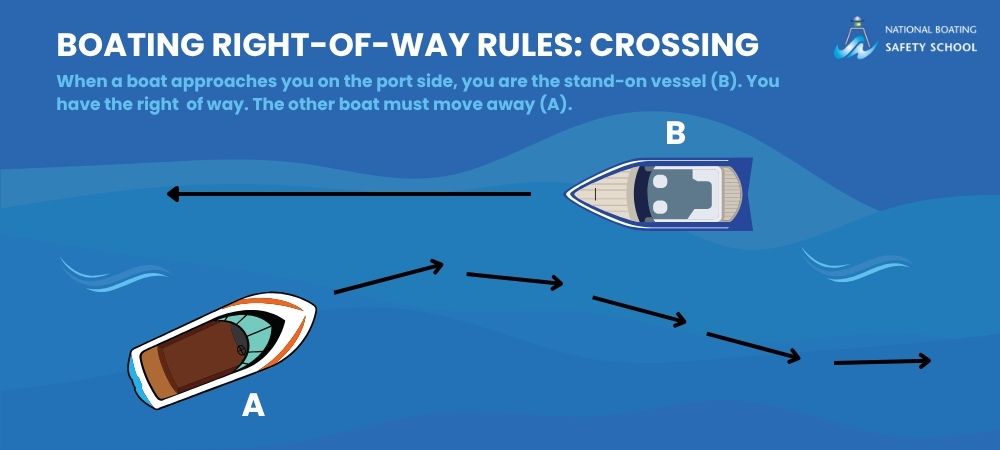
When a boat approaches you on the port side
In a situation involving two power-driven vessels where vessel A is approaching the port side of your boat (B), you are the stand-on vessel (you have the right of way).
To avoid a collision, maintain your course and speed.
If it becomes apparent that the give-way vessel (vessel A) is not performing the appropriate maneuver, you may take action to move out of the way.
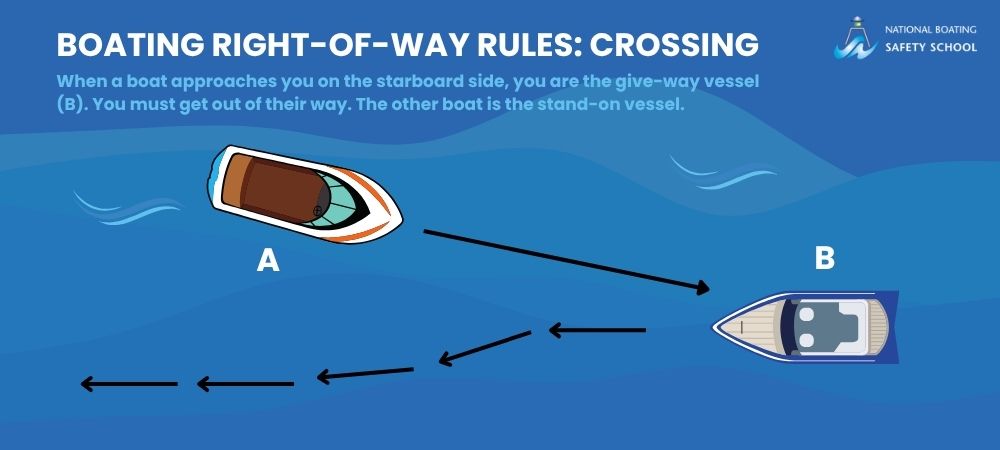
When a boat approaches you on the starboard side
In a situation where a power-driven vessel is approaching the starboard side of your boat and there is a risk of collision, you are the give-way vessel. You must move out of the way and avoid crossing in front of the other boat.
As the stand-on vessel, the other boat has right of way and must maintain speed and course.
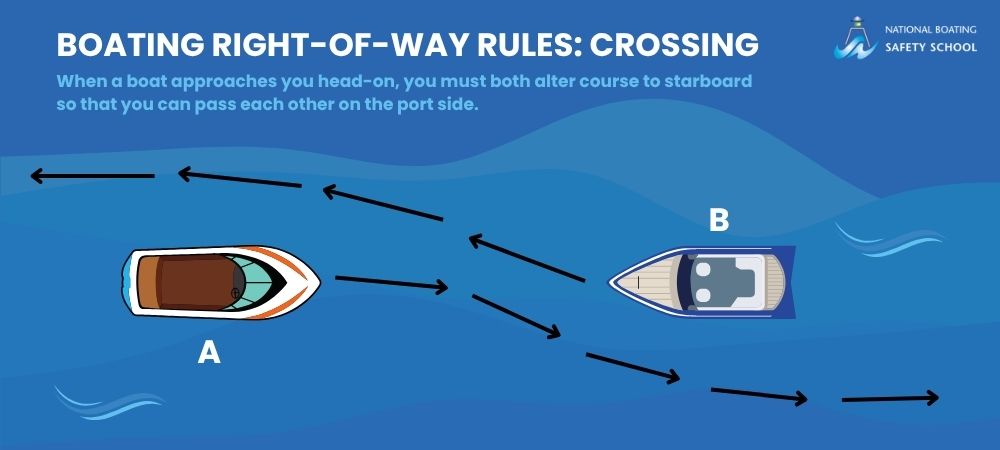
When two vessels approach one another directly, head-on
If a power-driven vessel (A) is approaching your boat (B) head-on and there is a risk of collision, you must both alter course to starboard so that you can pass each other on the port side.
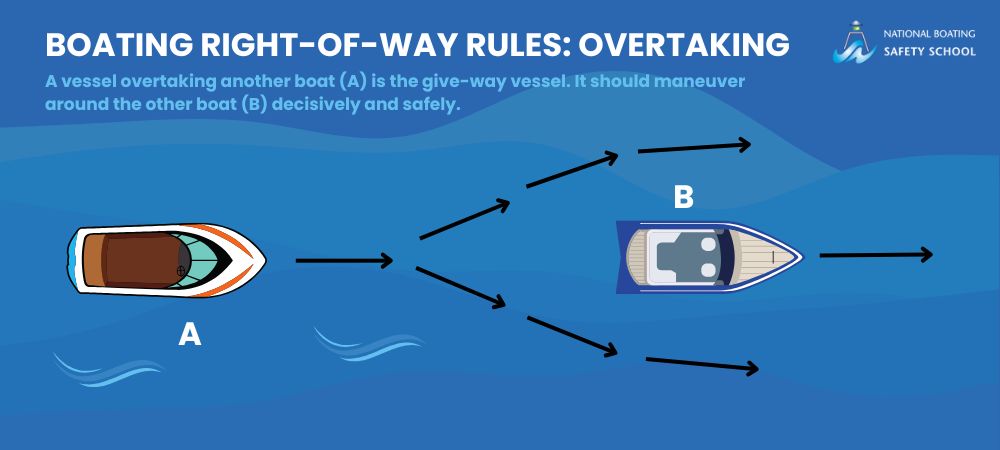
Rules for overtaking another vessel
A vessel that is overtaking another vessel is always the give-way vessel. The vessel being overtaken is the stand-on vessel.
A vessel overtaking another boat should maneuver around it decisively and safely, using appropriate signalling where necessary, so as to leave it adequate room to continue on its course.
The National Boating Safety School safe boating course will prepare you to obtain your Pleasure Craft Operator Card
The National Boating Safety School offers a Transport Canada approved boating safety course that will prepare you for the official online boating exam. Once you pass the test, you will be awarded your lifetime Pleasure Craft Operator Card. Register today!
Frequently Asked Questions
1. What is a stand-on vessel and what is a give-way vessel?
A stand-on vessel is the vessel that must maintain its course and speed. It has the right of way in a particular situation, meaning other vessels are expected to take action to avoid it. However, this right of way is not absolute.
If it becomes clear that a give-way vessel is not taking appropriate action to avoid a collision, the stand-on vessel is then obligated to take action to avoid the collision itself.
The give-way vessel is the vessel that must take early and substantial action to keep out of the way of the stand-on vessel.
This action can involve stopping, slowing down, or changing course. Any change in course or speed should be large enough to be clearly apparent to the other vessel, and a series of small, indecisive changes should be avoided. The give-way vessel should avoid crossing ahead of the stand-on vessel
2. Do sailboats or human-powered vessels always have the right-of-way over powerboats?
Generally yes, but rules may vary in specific scenarios. Remember, all boaters are responsible for avoiding collisions.
3. What does it mean to maintain a “proper lookout” to avoid a collision?
Keeping a lookout means using all available senses and equipment (including radar, if available) to be aware of your surroundings, at all times.
4. When should I use the “danger” sound signal to avoid a collision?
Five (or more) short, rapid blasts of a horn or whistle is the danger signal for all vessels on Canadian waterways.
It can be used to mean:
- Danger!
- I do not understand your intentions.
- I disagree with your proposed maneuver.
5. What should I do if I don’t understand another boater’s intentions?
If you are unsure what to do, it's generally a good idea to reduce your speed or even stop your vessel. This gives both you and the other boater more time to assess the situation and react.
Always be prepared to take evasive action. If you do need to alter your course or speed, make the change significant and obvious so the other vessel can clearly see your intentions. A series of small, hesitant changes can cause more confusion.
6. Who is held responsible for a boating collision?
Regardless of who is the stand-on or give-way vessel, everyone has a responsibility to avoid a collision. Boaters are also responsible for reporting a boating accident should one occur.
Sources
- Government of Canada Collision Regulations (C.R.C., c. 1416). Justice Laws Website. https://laws-lois.justice.gc.ca/eng/regulations/C.R.C.,_c._1416/section-sched512871.html?txthl=give
- Government of Canada Vessel Operation Restriction Regulations. Justice Laws Website. https://laws-lois.justice.gc.ca/eng/regulations/sor-2008-120/page-10.html
- Government of Canada Marine Transportation: Chapter 12 - Obey the "Rules of the Road". https://tc.canada.ca/en/marine-transportation/marine-safety/chapter-12-obey-rules-road
- Transport Canada. SAFE BOATING GUIDE Safety Tips and Requirements for Pleasure Craft. . https://tc.canada.ca/sites/default/files/2024-03/tp_511e.pdf
Related CONTENT
LAtest ARTICLES