PFD Rules and Regulations in Canada
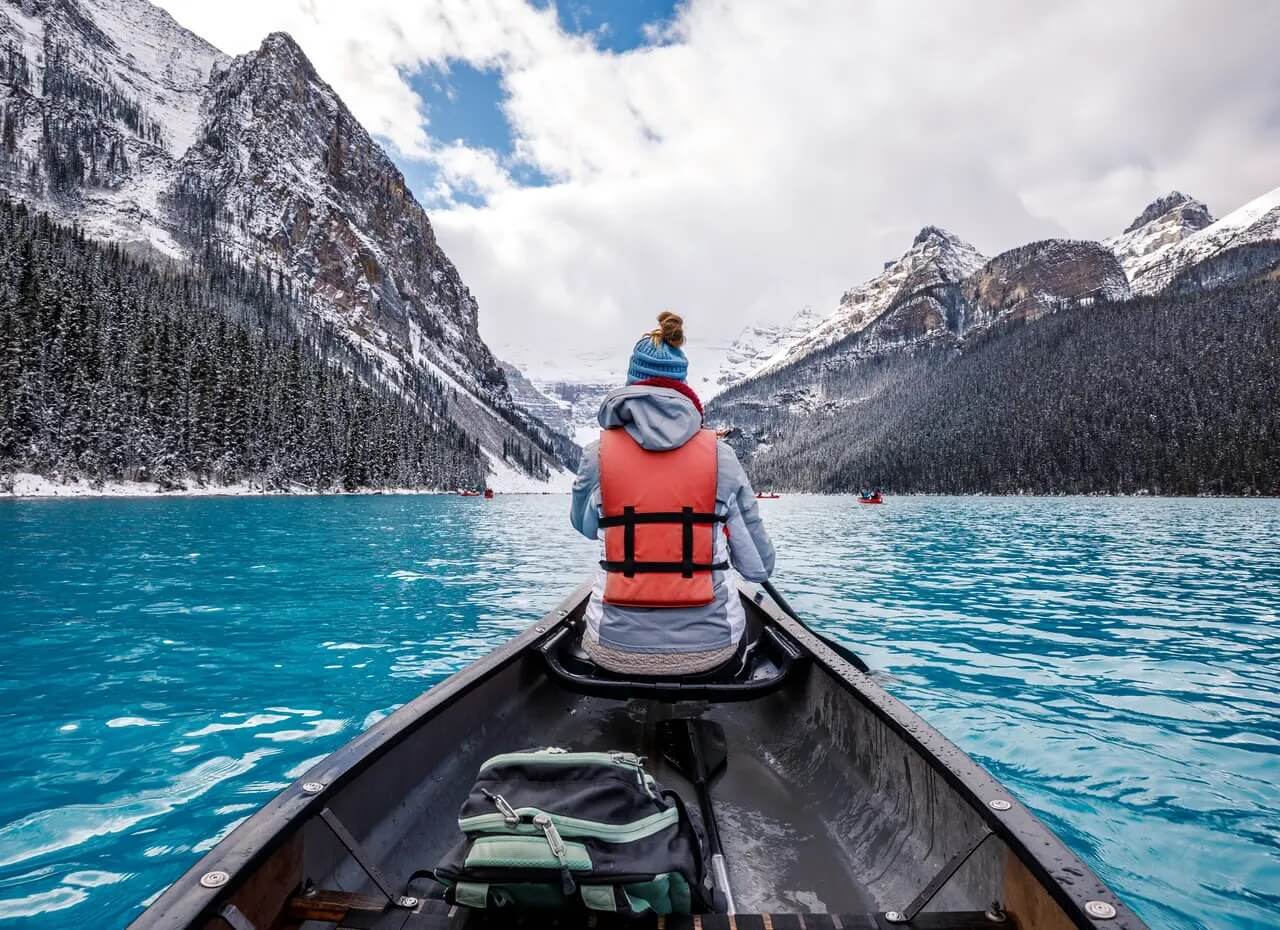
Personal Flotation Devices or PFDs, otherwise known as life jackets, are key to safety when boating or near water. But just taking your PFD with you to the beach or on a boat isn’t going to keep you safe: you have to wear it! And, you have to wear an approved model that is right for your size, age, swimming ability and activity.
Key takeaways
- There is currently no Canadian law forcing people to wear PFDs (Personal Flotation Devices).
- However, the law stipulates that boaters must always have one approved, correctly-fitted PFD on board with easy reach for each person on a boat.
- The old Type system of labeling PFDs is being replaced with a Buoyancy Level system. PFDs with old labels can still be worn if they are in good condition.
- PFDs used in Canada must be approved by Transport Canada, Canadian Coast Guard, or Fisheries and Oceans Canada.
- PFDs come in foam-filled, inflatable, and children’s styles.
- There are three approved PFD designs in Canada: SOLAS, standard life jackets, and small vessel life jackets.
Table of contents
What is a PFD (Personal Flotation Device)?
A PFD is a vest, or sometimes a suit, that is worn by any person on, in or near the water to prevent them from drowning. Most PFDs are flotation devices that you can wear, such as life jackets, however there are also some approved throwable PFDs.
A properly worn life jacket is essential safety equipment for anyone heading out on a boat. It does more than just help you float:
- A PFD keeps a person on the surface of the water even if the wearer is injured or unconscious.
- It will reduce the initial impact of falling into water.
- It will help prevent cold water shock.
- It can help the wearer reach safety or stay afloat until they are rescued.
When do you have to wear a PFD?
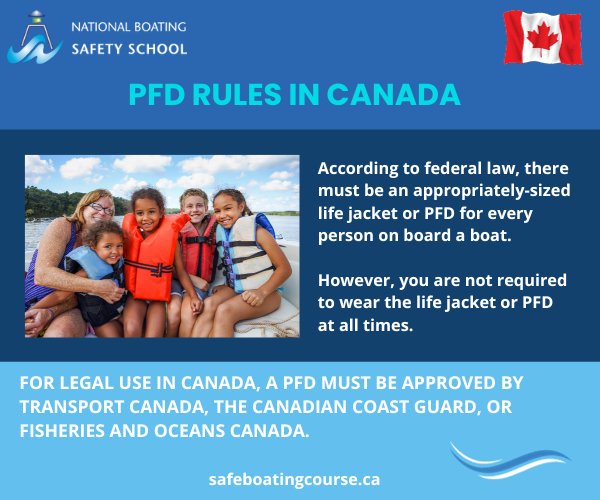
While Canadian law does not enforce wearing a life jacket on a boat or when in or near water, you are required by law to have an appropriate, approved life jacket on board for each person on the boat. It must be within easy reach of the person who will use it.
Even strong swimmers should wear a PFD. It will keep you safer while performing all types of water activities, including:
- Boating in all types of motorised and human-powered vessels;
- Water skiing;
- Windsurfing;
- Paddleboarding;
- Operating a PWC;
- Fishing.
Remember, laws do change, so it’s important to keep up to date. As of the publication of this article, provincial legislation in Ontario and elsewhere in Canada is being revised, and it is possible that wearing a life jacket may become obligatory in the near future.
PFD approval in Canada
All life jackets and PFDs used for boating on Canadian waters must be approved by one of the following organisations:
There will also be a Canadian General Standards Board (CGSB) number on the same tag (Example: CAN/CGSB-65.7-M88).
New PFD labels are in effect
Older life jackets were categorised according to Type. Older PFDs are still usable, as long as they are in good working condition.
The Type system
Type I
For off-shore, high-risk activities where rescue could take a while. May turn the wearer on their back if unconscious.
Type II
Designed for use in calm, inland waters where a quick rescue is likely. May turn the wearer on their back if unconscious.
Type III
Designed for use in calm, inland waters where a quick rescue is likely. Will not turn the wearer on their back if unconscious.
The Buoyancy Level system
New labels show Buoyancy Level instead, using numbers from 50 to 150 (or even higher). Lower numbers mean less buoyancy.

Offshore

Waves

Calm

Near shore
PFD and life jacket styles approved for use in Canada
PFDs approved for use in Canada for recreational boating and watersports are available in a variety of styles, including:
Foam-filled
These PFDs offer less flotation than life jackets, have limited turning capacity, but are smaller and less bulky so can be a comfortable alternative for strong swimmers. Available in a variety of styles and colours.
Inflatable
Inflatable PFDs can either be manually inflated, or will inflate automatically when immersed in water using a carbon dioxide (CO2) cartridge. This type is only approved for wearers over 16 years of age who weigh more than 80 lbs (36 kgs), and can never be used while white-water paddling or operating or riding on a PWC.
Children’s PFDs and life jackets
These must meet additional safety standards to be acceptable:
- Children must wear an appropriate size and style based on their weight: the child wearing the device must weigh at least 9 kgs (20 lbs). Children cannot wear adult PFDs or life jackets.
- The device should have a large collar to support the head, and a safety strap that goes between their legs.
PFD and life jacket designs
Technically, a PFD and a life jacket are not the same thing, however the terms are often used synonymously.
There are three life jacket designs approved for use in Canada:
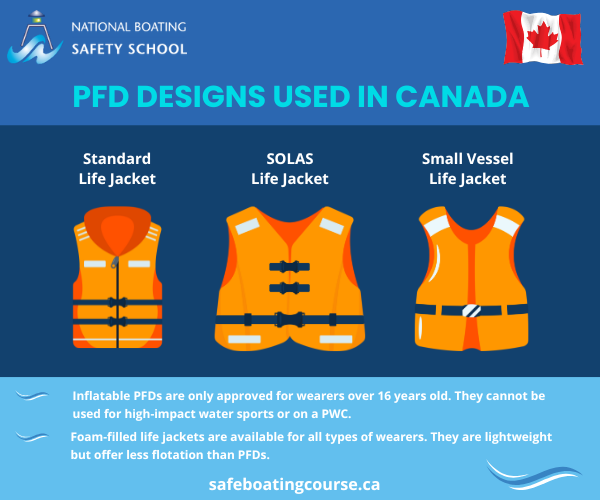
SOLAS (Safety of Life at Sea)
These life jackets are approved for use on all types of vessels. Available in both foam and inflatable models, these will keep your head above water. They come in models for wearers over 70 lbs and under 70 lbs (32 kgs).
Standard life jackets
Approved for all vessels except SOLAS vessels. These will also keep your face out of the water and come in models for wearers over 88 lbs and under 88 lbs (40 kgs).
Small vessel life jackets
These are approved for small vessels only, as they are less buoyant than standard life jackets. They will also turn an unconscious wearer onto their back, but more slowly, and they come in two models: keyhole and vest. They are available in three sizes: over 90 lbs (41 kgs), between 40lbs (18 kgs) and 90 lbs 41 kgs), and less than 40 lbs (18kgs).
The National Boating Safety School safe boating course will prepare you to obtain your Pleasure Craft Operator Card
The National Boating Safety School offers a Transport Canada approved boating safety course that will prepare you for the official online boating exam. Once you pass the test, you will be awarded your lifetime Pleasure Craft Operator Card. Register today!
Frequently Asked Questions
1. Why wear a PFD?
Not wearing a life jacket or PFD greatly increases your risk of drowning, even near the shore or in shallow water. You are at even greater risk of you are boating under the influence (which is illegal). Even confident swimmers should wear a life jacket to increase their chances of surviving adverse or unexpected circumstances.
The Canadian Red Cross states that wearing a life jacket could eliminate almost 90% of all boating-related drownings. More than 500 people in Canada drown every year, and many were not wearing a PFD, or not wearing one correctly, at the time of their death. While it is legally permitted not to wear a life jacket, you could save your life by keeping it on.
2. How can I tell if my life jacket is too old to use?
Life jacket labels do not include an expiration date, however you should use good judgement. If the jacket is sagging, ripped, missing straps, or damaged in any other way, it should be discarded. Always test a PFD in shallow water before taking it out on a boat.
Sources
- Transport Canada. SAFE BOATING GUIDE. . https://tc.canada.ca/sites/default/files/2024-03/tp_511e.pdf
- Lifejacket Wear and Boating Safety. . https://cdn.redcross.ca/prodmedia/crc/documents/Tipsheet_LifejacketBoating_2017.pdf
- There's no life jacket law, but police and safety advocates say 'there's really no excuse' not to wear them. CBC News. https://www.cbc.ca/news/canada/sudbury/water-boating-safety-life-jacket-use-1.7537624
- Choosing lifejackets and personal flotation devices (PFDs). Transport Canada. https://tc.canada.ca/en/marine-transportation/marine-safety/boating-safety/choosing-lifejackets-personal-flotation-devices-pfds
Related CONTENT
LAtest ARTICLES