Boat Hull Types and Designs
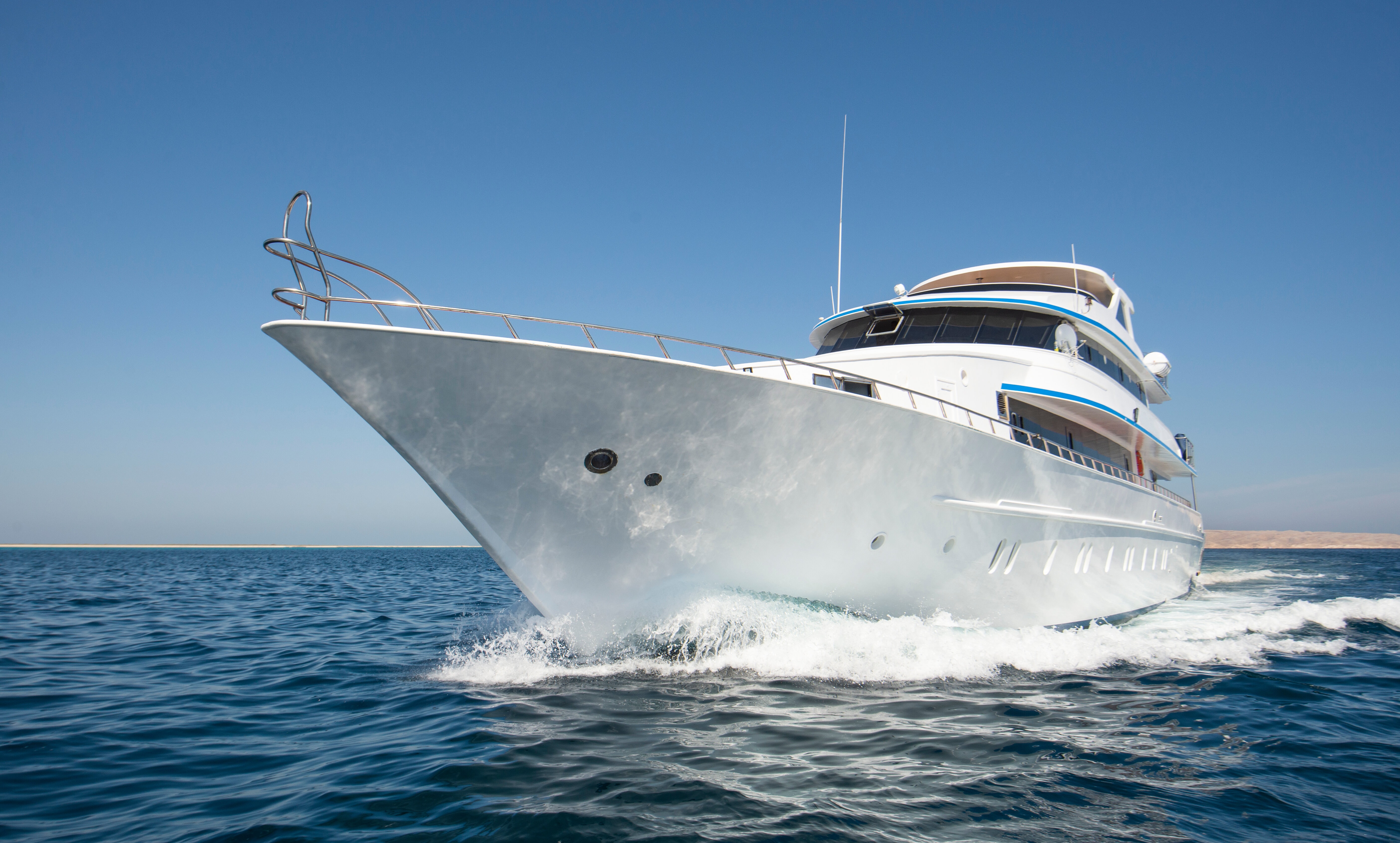
When it comes to boats, the hull type is really important. It’s not just about looks – the way a boat’s hull is shaped determines what the boat can do on the water. There are different types and designs of hulls for different jobs.
Some hulls move through the water by pushing it aside, making the ride steady and smooth. Others are designed to skim on top of the water, which is called “planing.” And there are many different shapes within these two categories, each suitable for specific purposes. Whether you want a gentle ride or you’re looking for thrilling speed, your boat hull type will determine what kind of boating experience you will have.
Key takeaways
- There are several different types of boat hulls. The hull design will affect how efficiently the boat moves through the water and how stable it will be.
- Boat hull designs include: displacement hulls (including round-bottom-hulls); planing hulls (including flat-bottom and V-shaped hulls); and multi-hulls.
Table of contents
What is a boat hull?
To start, let’s go over some terms. The hull is the main body of a boat. This is the part of the boat that is watertight, with the deck serving as a kind of roof over the hull. The point where the hull meets the water is called the waterline, and the angle at which the hull meets the water surface, measured in degrees, is known as the deadrise. Boaters often measure the deadrise at different points on a boat to evaluate how efficiently the vessel will move through the water.
Keep reading to learn about the main types of boat hulls, and the types of boating activities they are best suited to.
Displacement Hulls
Displacement hulls are commonly found in large ships, trawlers, and traditional recreational sailboats. While they might not allow for fast travel, these hulls are stable and can carry big loads with smaller propulsion systems. The bottom of displacement hulls is usually rounded, and ballast is positioned low in the center.
Displacement hulls are found in sailing boats, slow-moving vessels, and substantial watercraft like cruise ships. Their combination of weight and power makes them settle quite deep in the water, and when they move, they displace water rather than gliding across its surface. When not moving, these rounded hulls will generally roll in response to waves and swells.
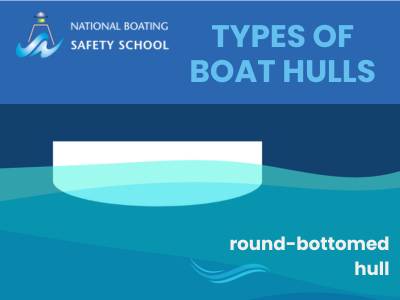
Round-Bottom Hulls
Hulls featuring a rounded bottom design are typically categorized as displacement hulls. They are engineered to move smoothly and effortlessly through the water, such as in the case of a canoe.
This design characteristic does have a drawback when it comes to stability. Use extra caution when embarking, disembarking, and loading these types of boats, because boats with round-bottomed hulls are likely to wobble and even capsize.
Planing Hulls
Powerboats and pwc’s often have planing hulls, which is one reason they can glide swiftly across the water’s surface at high speeds. At lower speeds, these hulls behave similarly to displacement hulls, but they can smoothly transition into a planing state at around 15-16 MPH, depending on individual boat design and weight. Planing hulls come in a variety of shapes, each with specific advantages and drawbacks.
These hulls are often found in smaller, faster boats.
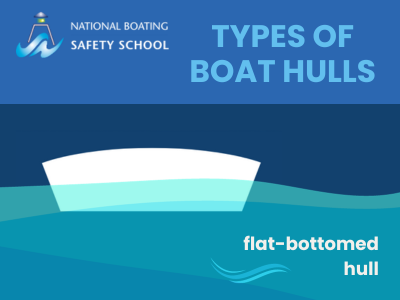
Flat-Bottom Hulls
Boats with flat-bottomed hulls are stable and are a good choice for transporting heavy loads. Not much engine power is needed to achieve planing, but keep in mind these boats do not offer a very comfortable ride on choppy waters or in heavy weather.
Small aluminum or fiberglass fishing boats often have flat hulls. They generally feature shallow drafts and plenty of deck space, making them well-suited to leisure activities, especially on calm waters like slow-flowing rivers and small lakes or ponds.
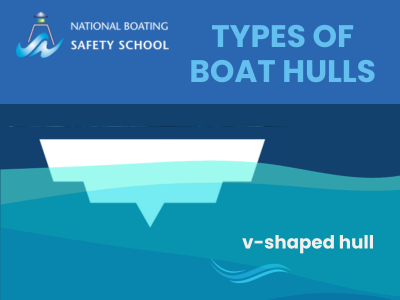
V-shaped, V-bottom or ‘Vee-shaped’ Hulls
V-shaped hulls slice through waves and offer a smooth ride even in choppy waters. However, they do require a more power achieve planing, and they can roll or bank when making sharp turns. V-shaped hulls also don’t offer much space for storage and passengers. These hulls are often found on fast, long-distance fishing boats, since they make it possible to cross open water quickly to get to fishing locations.
V-shaped Hulls are a popular type of hull for powerboats and fiberglass motorboats, which usually have larger engines. To understand the impact of your boat engine on your surroundings, it’s a good idea to learn more about your boat’s wake and wash.
Multi-Hulled Boats
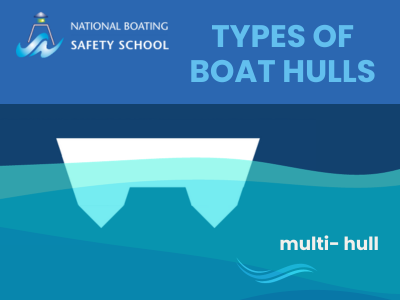
Multi-hulled boats have separate, distinct hulls, which can be either planing or displacement hulls. The type of hull depends on the size of the boat and the engine. Multi-hull water vessels include catamarans, trimarans, pontoons boats and some types of houseboats, which can be either sailboats or powerboats.
Multi-hull boats are very stable, but steering and turning them is only possible in larger bodies of water.
The National Boating Safety School safe boating course will prepare you to obtain your Pleasure Craft Operator Card
The National Boating Safety School offers a Transport Canada approved boating safety course that will prepare you for the official online boating exam. Once you pass the test, you will be awarded your lifetime Pleasure Craft Operator Card. Register today!
Frequently Asked Questions
1. What is the difference between an aluminum and a fiberglass hull?
Fiberglass is generally quieter, smoother riding, easier to repair cosmetically, and doesn't suffer from corrosion. Aluminum is significantly lighter (allowing for faster speeds with less power), tougher against impacts, and highly durable, but it can be noisy in rough water and requires careful protection against galvanic corrosion.
2. What is ``blistering`` on a fiberglass hull?
Blistering (or osmosis) is the most common issue for fiberglass hulls. It occurs when water slowly permeates the gelcoat and reacts with materials in the fiberglass, forming small, localized bubbles or blisters that compromise the hull structure over time. It typically requires sanding, drying, and barrier coating for repair.
3. What is the keel?
The keel is the main structural beam that runs along the bottom center of the hull. On sailboats, the deep fin keel contains weight (ballast) to provide stability and resist sideways motion. On powerboats, a shallow keel or skeg protects the propeller and provides directional stability (tracking).
4. What are strakes and chines?
Strakes are longitudinal ridges or steps built into the hull bottom. They help lift the boat onto a plane faster and provide lift while running. Chines are the edges or corners where the hull bottom meets the side of the boat. Hard chines help deflect spray and increase stability.
Sources
- Keel. (n.d.). In Wikipedia. Retrieved October 6, 2025, from https://en.wikipedia.org/wiki/Keel
- Chine (n.d.). In Merriam-Webster. https://www.merriam-webster.com/dictionary/chine
- Skeg (n.d.). In Britannica. https://www.britannica.com/technology/skeg
Related CONTENT
LAtest ARTICLES