
Trim Tabs and Boat Trim
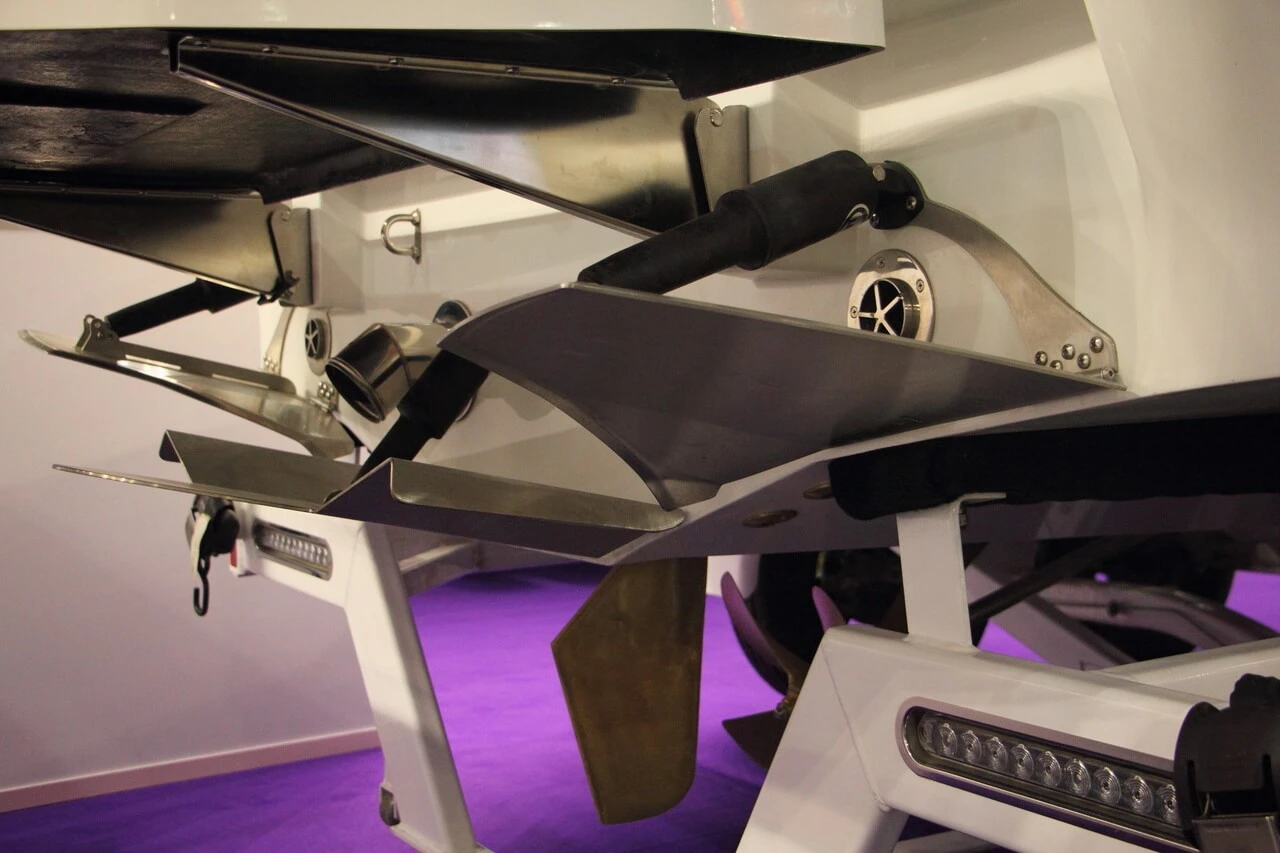
Boat trim—the angle at which a vessel rides on the water—is one of the most critical factors for performance, safety, and efficiency on the water.
While a boat's engine or drive unit provides the primary control over the front-to-back angle, trim tabs are an essential auxiliary system, consisting of adjustable plates mounted on the transom, that allow a boater to fine-tune the running angle precisely.
Key takeaways
- Trim is a boat's running angle (attitude) relative to the waterline, addressing both the front-to-back (longitudinal) and side-to-side (lateral) level.
- Trim tabs are adjustable plates on the stern used as an auxiliary system to precisely correct the boat's angle for optimal performance and stability.
- Trim tabs are particularly effective at correcting a side-to-side lean (list), which is often caused by uneven weight distribution (like passengers) or crosswinds.
- Proper use of trim and trim tabs leads to better fuel efficiency, higher speed, a smoother ride, and faster planing while also improving the driver's forward visibility.
- Trim settings should be constantly adjusted based on conditions: trim down (negative) to get on plane or cut through a head sea, and trim up (positive) once on plane in calm water or with a tailwind for maximum speed.
Table of contents
What is a boat’s trim?
The term "trim" refers to a boat's attitude or running angle—specifically, how the hull sits relative to the waterline, both front-to-back and side-to-side.
Adjusting a boat’s trim
A boat's trim is constantly adjusted by the operator to keep the boat running flat, comfortable, and efficient, regardless of passenger weight, wind, or wave conditions.
What are trim tabs?
Trim tabs make it possible to adjust a boat’s trim with even greater precision. They are small, adjustable plates mounted to the transom (the flat back end) of a powerboat. They are an auxiliary system used to fine-tune the running angle of the boat to achieve optimal performance, comfort, and stability.
Two main types of trim
There are two types of trim: longitudinal and lateral.
1. Longitudinal trim (bow-to-stern angle)
This is the most common use of the term ‘trim’. It is controlled by either shifting weight within the boat, by using the power trim system on the engine (outboard or stern drive), or by using trim tabs.
2. Lateral trim (side-to-side level)
This refers to the boat's level (or lack thereof) from port (left) to starboard (right). If the boat is leaning to one side, it is said to have a "list." Lateral trim is typically controlled by shifting weight (e.g., moving passengers) or, more effectively, by using trim tabs to push the low side of the stern up until the boat is running level.
Benefits of using trim tabs
Trim tabs can be used to improve your ride in several ways.
Comfort and stability
Trim tabs can be used to eliminate the list (side-tilt) often caused by weight shifts or crosswinds, making the ride more comfortable and making the boat less likely to capsize.
Improved performance (and fuel efficiency)
Trim tabs can hold the boat at its optimal running angle, resulting in better fuel economy and higher top speeds.
Faster planing
By pushing the bow down quickly, trim tabs help heavy boats get up onto a plane faster, improving safety and saving fuel.
Better visibility
Pushing the bow down eliminates the high-bow, "plowing" angle that often obstructs the driver's forward view before the boat fully planes.
When to use trim tabs to adjust your trim
Depending on the wind, weather and navigation conditions, trim settings will vary.
Rough or choppy waters
In rough water with tailwinds, your boat tends to have more weight on the bow. To avoid losing traction on your boat, you should raise the trim (turn it up). This takes the weight off the bow, which prevents the front of the boat from getting stuck in the waves.
Conversely, with a headwind, the bow will rise, weighing down the stern and increasing the wind load. The trim should then be lowered to lower the bow and reduce the impact of the hull and jumping.
Calm waters
In calm conditions, the trim will mainly help to lift the boat. Setting it to the negative position will increase its lift, making it easier to start. Once launched, you can then switch to positive to reduce the lift surface and increase speed.
You should be careful with positive trimming in calm waters. The impulse to increase speed can be a bad idea. Maintaining a positive trim will increase the ventilation effect and cause you to lose speed. In addition, depending on your hull, your boat will tend to pitch, especially during turns when it is better to keep the trim neutral.
Installing boat trim tabs: neutral, negative and positive trim
Boat trim tabs can be installed in three positions, depending on what you want them to do: neutral, negative and positive.
Neutral trim
This is the standard position, often used during navigation. The neutral trim position is parallel to the hull. It allows you to reach cruising speed by balancing speed and fuel consumption.
Negative trim
This position is often used for starting and raising the boat. The engine is lowered against the transom of the boat to facilitate propeller thrust. This position is also used during headwinds.
Positive trim
Positive trim is used when you want to use the full capabilities of your engine and reach maximum speed. The idea is that the higher the trim, the higher the RPM, which affects the speed. However, this position can also be useful when you need to regain control of the boat in rough waters with a tailwind.
The National Boating Safety School safe boating course will prepare you to obtain your Pleasure Craft Operator Card
The National Boating Safety School offers a Transport Canada approved boating safety course that will prepare you for the official online boating exam. Once you pass the test, you will be awarded your lifetime Pleasure Craft Operator Card. Register today!
Frequently Asked Questions
1. What is the difference between ``trim`` and ``tilt``?
Trim is the fine adjustment of the engine or drive unit's angle while the boat is underway to optimize its running attitude, speed, and efficiency.
Tilt is used to quickly raise or lower the entire engine or drive unit when the boat is stopped, typically for clearing the propeller, launching, or trailering.
2. What do ``trimming up`` and ``trimming down`` mean?
Trimming up (out) moves the engine/drive unit away from the transom, which raises the bow, reduces drag, and generally increases speed and fuel efficiency once on plane in calm water.
Trimming down (in/negative trim/full tuck) moves the engine/drive unit closer to the transom, which forces the bow down, helps the boat get "on plane" faster, and improves stability in rough water.
3. How do I know if my boat is properly trimmed?
A properly trimmed boat will generally ride smoothly and level, with minimal spray far forward on the hull, achieve its maximum speed for a given RPM, and provide the best fuel efficiency. If the bow is bouncing ("porpoising"), you've trimmed up too far.
4. Should I use my engine trim or my trim tabs first?
A common method is to use your engine power trim first to achieve the best fore-and-aft running attitude for efficiency and speed. Then, use your trim tabs for fine-tuning, especially to correct for any side-to-side list or to adjust the bow for varying sea conditions.
Related CONTENT
LAtest ARTICLES