Marine Charts: What They Are and How to Read One
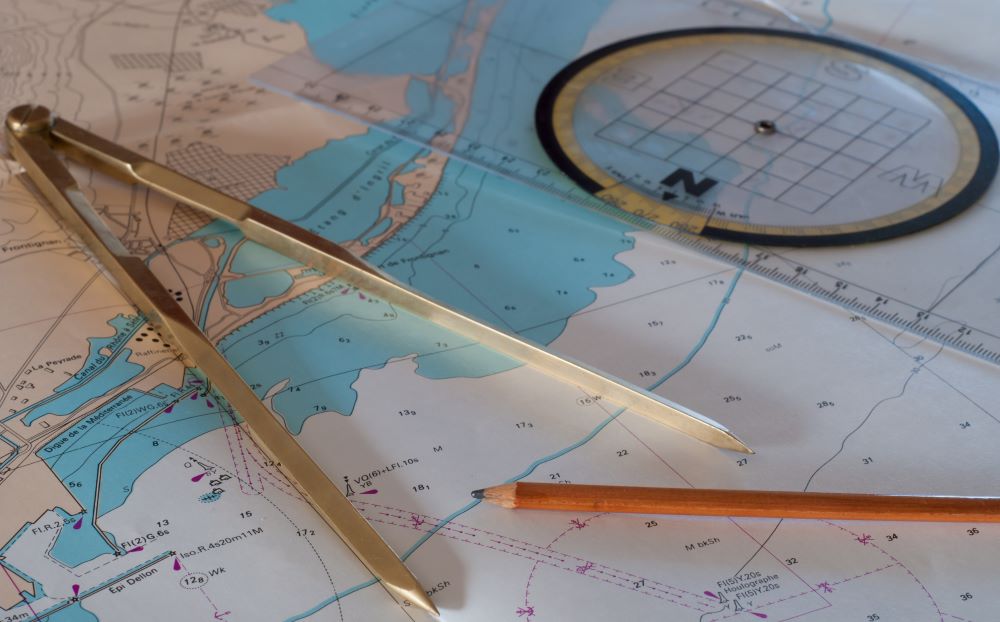
A nautical chart, also called a marine chart, is a specialized map used for navigation on the water. It is a detailed map of a water body and its adjacent coasts, and provides information that a standard land-based map does not.
Recreational boaters in Canada should be able to read a nautical chart to navigate safely and avoid being stranded.
Key takeaways
- Nautical charts are specialized maps for water navigation. Unlike regular maps, they provide critical details for boaters, such as water depths, navigational aids (buoys, lighthouses), hazards, and shoreline features. In Canada, they are published by the Canadian Hydrographic Service (CHS).
- Colors indicate water depth.
- Charts use a variety of numbers and letter abbreviations to indicate water depth, potential dangers, and different types of seabed compositions.
- Reading a chart is a multi-step process: First, you must understand the basic information in the title block, like the scale and units of measurement. You must also learn to interpret the colors, symbols, and abbreviations. Finally, you should know how to use a magnetic compass and the chart's compass rose to account for magnetic variation.
Table of contents
- What are nautical charts used for?
- Types of water bodies covered by nautical charts
- Understanding marine chart symbols
- Reading a nautical chart in practice
- 1. First, make sure you understand the chart's basic information
- 2. Learn to interpret water depths and colors
- 3. Know the language of the chart: symbols and abbreviations
- 4. Learn to use a magnetic compass, then refer to the compass rose
- 5. Plot your position and refer back to the chart to navigate safely
- Frequently Asked Questions
What are nautical charts used for?
Nautical charts are a representation of the ocean floor and other features in the form of a paper or digital map. They are published by the Canadian Hydrographic Service (CHS) in Canada, and meet official standards for accuracy and reliability.
A nautical chart helps recreational boaters identify hazards and avoid running aground or causing an accident.
Your chart will show:
- Water depths: Shown with numbers (soundings) and contour lines (isobaths) to indicate the shape of the seabed.
- Navigational aids: The location and characteristics of buoys, lighthouses, and other markers.
- Hazards to navigation: The presence of rocks, wrecks, shoals, and other obstructions.
- Shoreline features: Details about the coast that are useful for position-fixing.
- Other information: Such as tidal information, magnetic variation, and restricted areas.
Types of water bodies covered by nautical charts
The CHS focuses its efforts on charting commercially important waterways, major coastal areas, and popular recreational lakes and rivers. Many smaller lakes and remote rivers may not have official nautical charts.
Understanding marine chart symbols
A nautical chart contains various symbols, abbreviations and terms. Like a fishing chart, it is drawn following the contour lines and nature of the seabed. The nomenclature is used internationally and is adapted according to the country.
Marine chart colours
The colours on a nautical chart indicate the depths and types of seabed. Here is what each colour represents:
- White represents deep water, when you are off the coast.
- Blue represents shallow water, between 0 and 10 meters. The darker the blue, the less water there is. You are therefore getting closer to the shoreline.
- Green indicates the foreshore. In other words, the strip of coastline that is covered at high tide, but uncovered at low tide.
- A yellow brown indicates the shoreline.
- Pink represents the lighthouses at harbor entrances, underwater cables and restricted areas.
Depth, soundings and isobaths
The numbers on a marine chart provide more information about the depth of the waterbed and give a more specific indication of elevation. They can also indicate the presence of objects or rocks that are not always visible depending on tides and weather conditions.
- A single, italicized number indicates a sounding that is always covered, regardless of the tide level. 5 indicates 5m of water with a bottom at -5m below sea level during low tides. Isobaths (depth) will be highlighted in blue.
- An italicized and underlined number symbolizes the height of the bedrock when it is uncovered at low tide. If it is in parentheses, it indicates an offset between the actual location and the sounding.
- A number in brown italics indicates the land elevation of the coast. The lettered abbreviations will provide more detail on the hazardousness of the soundings:
| ED | Existence doubtful |
| SD | Sounding doubtful |
| REP | Reported, but not surveyed |
Letters
Often near the shore, these markers indicate the characteristics of the waterbed. This information is important for anchoring a boat.
Capital letters
These indicate the type of bed:
| S | Sand |
| R | Rock, Rocky |
| M | Mud |
| Wd | Weed (including kelp) |
| Sh | Shells (skeletal remains) |
| St | Stones |
| G | Gravel |
| P | Pebbles |
| Bo | Boulders |
| Co | Coral and Coralline algae |
When two letters are separated by a slash, this indicates that you are dealing with a mixed seabed. The first letter will always indicate the majority type.
Lower case letters
They will indicate the quality of the seabed:
| so | Soft |
| f | Fine |
| m | Medium |
| sy | Sticky |
| sf | Stiff |
| h | Hard |
| bk | Broken |
Danger warnings
Depending on the waters you navigate, you may find letters that indicate other dangers:
| Wk | Wreck |
| Obstn | Obstruction |
| Coral | Coral Reef |
Reading a nautical chart in practice
Knowing how to read a nautical chart is a key step in becoming a confident boater. Here are the steps to effectively read a nautical chart while on the water:
1. First, make sure you understand the chart's basic information
Look for the title block, usually in a corner of the chart. It contains vital details such as the maps’ Scale (e.g., 1:20,000), units of measurement (feet, fathoms, or meters) and datum (reference point for depths and heights).
2. Learn to interpret water depths and colors
As described above, nautical charts use a combination of numbers, colors and contour lines to show water depth. Make sure you can interpret these easily before heading out on the water.
3. Know the language of the chart: symbols and abbreviations
Charts are filled with symbols that represent everything from hazards to navigational aids. It's a language you must learn to read before attempting to navigate.
4. Learn to use a magnetic compass, then refer to the compass rose
A magnetic compass is a required piece of boating safety equipment in Canada. Once you know how to use it, refer to the compass rose, a circular design, on your nautical chart. It has two scales:
- An outer scale that points to True North (the geographic North Pole).
- An inner scale that points to Magnetic North (the direction your compass needle points). The difference between these two is called magnetic variation, and it's a key piece of information you need to adjust your compass readings for accurate navigation.
5. Plot your position and refer back to the chart to navigate safely
Use the latitude and longitude grid on the edges of the chart to determine your exact position. Plotting your position on a paper chart can be done with a straightedge and dividers, using landmarks and navigational aids to confirm your location. A digital chart will have built-in plotting functions.
The National Boating Safety School safe boating course will prepare you to obtain your Pleasure Craft Operator Card
The National Boating Safety School offers a Transport Canada approved boating safety course that will prepare you for the official online boating exam. Once you pass the test, you will be awarded your lifetime Pleasure Craft Operator Card. Register today!
Frequently Asked Questions
1. What is the difference between a nautical chart and a regular map?
A regular map shows roads, buildings, and land features. A nautical chart focuses on hydrographic data, which includes water depths, underwater topography, and navigational hazards that aren't on a standard map.
2. Do buoys and markers on a chart match what's on the water?
Yes, but they are not always a perfect match. Charts use specific symbols to represent the type, color, and characteristics of buoys and markers. While the Canadian Coast Guard maintains these aids to navigation, things like currents, weather, or vessel collisions can cause a buoy to shift from its charted position. Therefore, mariners are advised to always keep a lookout and not rely solely on the chart.
Sources
- Government of Canada. Nautical charts and services. Navigating. https://charts.gc.ca/index-eng.html
- Government of Canada. About the Canadian Hydrographic Service. Nautical Charts and Services. https://www.charts.gc.ca/help-aide/about-apropos/index-eng.html
Related CONTENT
LAtest ARTICLES