
Recognizing Marine Buoys and Markers in Canada
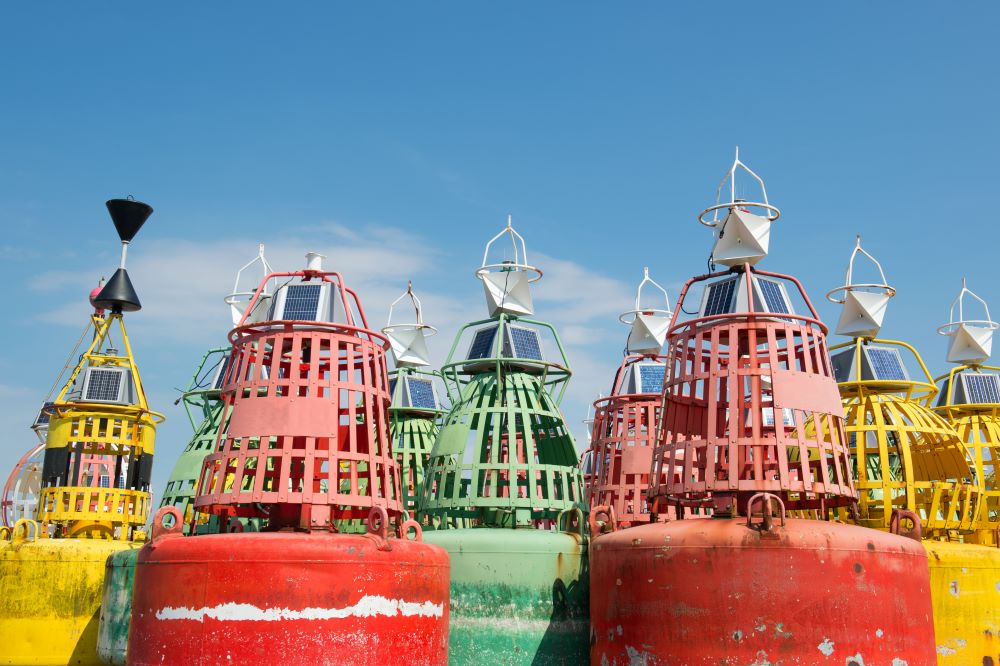
Buoys and markers are floating devices that are used to guide boats on the water and provide important navigational information. They are also called floating aids to navigation.
Knowing about buoys and markers is a fundamental part of responsible and safe boating, just like knowing traffic signs is for driving a car. It's a key component of the boater safety education required to obtain a Pleasure Craft Operator Card (PCOC) in Canada.
Key takeaways
- Buoy shape can vary (e.g., pillars, spars, spheres). However, it is the color, pattern and markings that communicate a signal or direction.
- Buoys help boaters avoid hazards (like rocks and shoals), navigate safely by marking channels, and comply with federal boating regulations.
- The "lateral system" is key for navigation. This system uses red and green buoys to mark the sides of a channel. The "red, right, returning" rule is a memory aid for staying in the safe part of a channel when heading upstream.
- Different buoy types have specific meanings. The Canadian system includes distinct categories of buoys, including lateral buoys, fairway buoys, isolated danger buoys, cardinal buoys, and special purpose buoys.
Table of contents
Buoys and markers come in several shapes
Marine buoys and markers can come in many different shapes, including:
- Beacons
- Spars
- Spherical buoys
- Conical buoys
- Pillars
Colour and pattern are what give buoys their meaning. Many buoys are equipped with lights to make them easier to see in the dark and in reduced visibility.
General function of buoys and markers
Buoys and markers serve several important functions when it comes to boating safely:
Avoiding hazards and staying safe
Buoys and markers are designed to warn boaters of potential dangers such as submerged rocks, shoals, wrecks, and shallow water. Without understanding them, you could easily run aground or collide with a hidden obstacle, putting yourself and your passengers at risk.
Many buoys are equipped with lights, bells, or whistles that operate at night or in low-visibility conditions. Knowing how to interpret the colors, flash patterns, and sounds of these aids is also key for safe boating after dark or in fog.
Navigation
In rivers, harbors, and even large lakes, buoys mark the boundaries of a safe, navigable channel. They tell you where to go and, just as importantly, where not to go. Understanding the "lateral system"—specifically the "red, right, returning" rule—is essential for staying within a safe channel.
Beyond marking channels, buoys and markers provide other vital information, such as a temporary danger, an anchorage area, speed limits or a restricted area.
Compliance with regulations
Boating in Canada is governed by federal regulations. These rules require you to understand and follow the aids to navigation system. Failure to do so could lead to an accident and potential legal liability.
Types of buoys
In order to be able to comply with regulations, boaters need to be able to recognize the following types of buoys and their meanings:
Lateral buoys
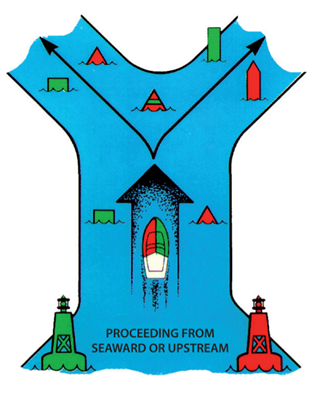
Lateral buoys are used to mark the side of the waterway that boaters should use when heading upstream. Following the routes indicated by these buoys helps boaters avoid collisions and dangerous obstacles.
Port hand buoys
Port hand buoys are coloured green and marked with odd numbers. They should be kept on your port (left) side as you head upstream.
Starboard hand buoys
Starboard hand buoys are coloured red and marked with even numbers. They should be kept on your starboard (right) side as you head upstream.
Bifurcation buoys
Bifurcation buoys mark the point where a waterway splits in two and indicate the route for vessels moving upstream. The main or preferred channel is indicated by the colour of the uppermost band.
For example, port bifurcation buoys are green with a horizontal red band and indicate that the recommended route is on the starboard (right) side of the buoy.
Starboard bifurcation buoys are red with a horizontal green band and indicate that the recommended route is on the port (left) side of the buoy.
Fairway buoys
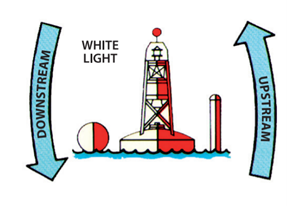
Fairway buoys indicate safe water. They have red and white vertical stripes of equal width. They may carry a topmark that consists of a single red sphere.
You may pass a fairway buoy on either side, but it is preferable to keep it on your port (left) side.
Isolated danger buoys
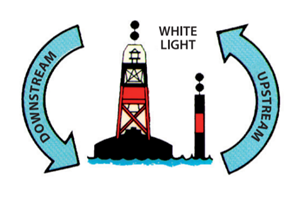
Isolated danger buoys mark a hazard surrounded by navigable water. They are black with one horizontal red band. They may also carry a topmark that consists of two black spheres, one on top of the other.
Cardinal buoys
Cardinal buoys are black and yellow buoys that indicate the safest or deepest water using the cardinal points of a compass.
There are four types of cardinal buoys, one for each cardinal point.
North cardinal buoy

A north cardinal buoy indicates that safe water can be found north of it. The top half of the buoy is black, and the bottom half is yellow.
East cardinal buoy

An east cardinal buoy indicates that safe water can be found east of it. The buoy is black with one broad yellow band.
South cardinal buoy

A south cardinal buoy indicates that safe water can be found south of it. The top half of the buoy is yellow, and the bottom half is black.
West cardinal buoy

A west cardinal buoy indicates that safe water can be found west of it. The buoy is yellow with one broad black band.
Special buoys
Special buoys provide boat operators with specific information. Pleasure boaters need to know the meanings of these types of buoys in addition to those listed above.
Mooring buoys

Mooring buoys are used to moor vessels. Their top third is orange and the rest is white.
Anchorage buoys

Anchorage buoys mark the perimeter of an anchorage area. They are yellow with black anchor symbols.
Cautionary buoys

Cautionary buoys mark danger areas (military exercise areas, underwater structures, areas with no safe channel, etc.) They are entirely yellow.
Control buoys

Control buoys mark areas where boats are restricted and must obey specific rules (speed limits or wash restrictions, for example). They are white with orange bands and an orange circle.
Keep-out buoys

Keep-out buoys mark areas where boats are prohibited. They are white with orange bands and an orange diamond containing a cross.
Hazard buoys

Hazard buoys mark dangers such as rocks or turbulent waters. They are white with orange bands and an orange diamond.
Diving buoys
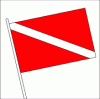
Diving buoys mark scuba diving areas that boats should keep well away from. These buoys are white and sport a red flag with a diagonal white stripe.
Swimming buoys

Swimming buoys mark the perimeter of a swimming area. They are entirely white.
Information buoys

Information buoys provide information for boat operators (the name of the location, marina, etc.). They are white with orange bands and an orange square.
The National Boating Safety School safe boating course will prepare you to obtain your Pleasure Craft Operator Card
The National Boating Safety School offers a Transport Canada approved boating safety course that will prepare you for the official online boating exam. Once you pass the test, you will be awarded your lifetime Pleasure Craft Operator Card. Register today!
Frequently Asked Questions
1. Is it against the law to tie my boat to a buoy?
Yes. It is illegal and dangerous to tie up to an official aid to navigation. Doing so can cause damage to the buoy, interfere with its function, and put other boaters at risk.
2. What do upstream and downstream have to do with understanding buoys?
Knowing the difference between upstream and downstream is key to interpreting buoys correctly and interpreting the "red, right, returning" rule.
3. What does ``red, right, returning`` mean in Canada?
This is a simple phrase to remember the lateral system. When you are "returning" from seaward (i.e., heading upstream), you should keep the red buoys on your starboard (right) side. This will keep you on the correct side of the channel. Conversely, when heading downstream, you keep the red buoys on your port (left) side.
4. What should I do if I see a buoy that is off its station or damaged?
If you encounter a buoy that appears to be off its designated position, damaged, or unlit when it should be, you should report it to the nearest Canadian Coast Guard Marine Communications and Traffic Services (MCTS) center. This helps ensure that the safety of other boaters is not compromised.
Sources
- Government of Canada. TP 14542 – Cardinal Buoys and Special Buoys (2022) Transport Canada. https://tc.canada.ca/en/marine-transportation/publications/tp-14542-cardinal-buoys-special-buoys-2022
- Government of Canada. TP 14541 – Lateral Buoys and Standard Daybeacons (2022) Transport Canada. https://tc.canada.ca/en/marine-transportation/publications/tp-14541-lateral-buoys-standard-daybeacons-2022
Related CONTENT
LAtest ARTICLES