Navigation Lights Rules for Boating in Canada
Navigation lights are a mandatory part of a boat's safety equipment. All boaters, whether recreational or professional, must know which lights to display and when to display them to ensure safe travel. The type and number of lights required depend on the vessel's size and design.
Key takeaways
- Navigation lights help vessels see and be seen. They also signal their type, position, and direction of travel.
- Navigation lights are a mandatory part of a boat's safety equipment under the Canadian Collision Regulations.
- Navigation lights must be used from sunset to sunrise and at any time during the day when visibility is restricted due to conditions like fog, heavy rain, or snow.
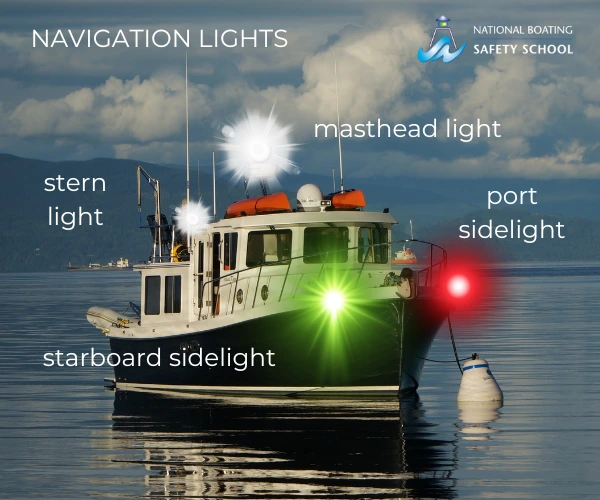
- The four main types of navigation lights on pleasure boats are: masthead light (white, shines forward); sidelights (red on the port side, green on the starboard side); sternlight (white, shines backward); and all-round white light (visible 360 degrees).
- The required combination of lights depends on the boat's size and type.
- A boater must know the difference between port (red light) and starboard (green light) to interpret navigation lights. They must also know the “rules of the road” so they can react appropriately to what they see.
Table of contents
What are navigation lights for on a boat?
Generally, the purpose of navigation lights is to make it easier to see and be seen by other boats.
They can also help determine which vessel has the right of way in crossing situations, because they provide information on the type and status of the boat in question (anchored, fishing, towing, being towed, etc.) That’s why navigation lights are mandatory under the Canadian Collision Regulations.
Main types of navigation lights
There are four main types of navigation lights for pleasure boats in Canada.
1. Masthead light
This white light is mounted on the front part of a vessel’s mast, above the sidelights. It projects uninterrupted light forward across the horizon in a 225° arc.
2. Sidelights
Sidelights consist of a red light on the port side and a green light on the starboard side, as close as possible to the bow (the front of the boat). Each projects uninterrupted light across the horizon in a 112.5° arc.
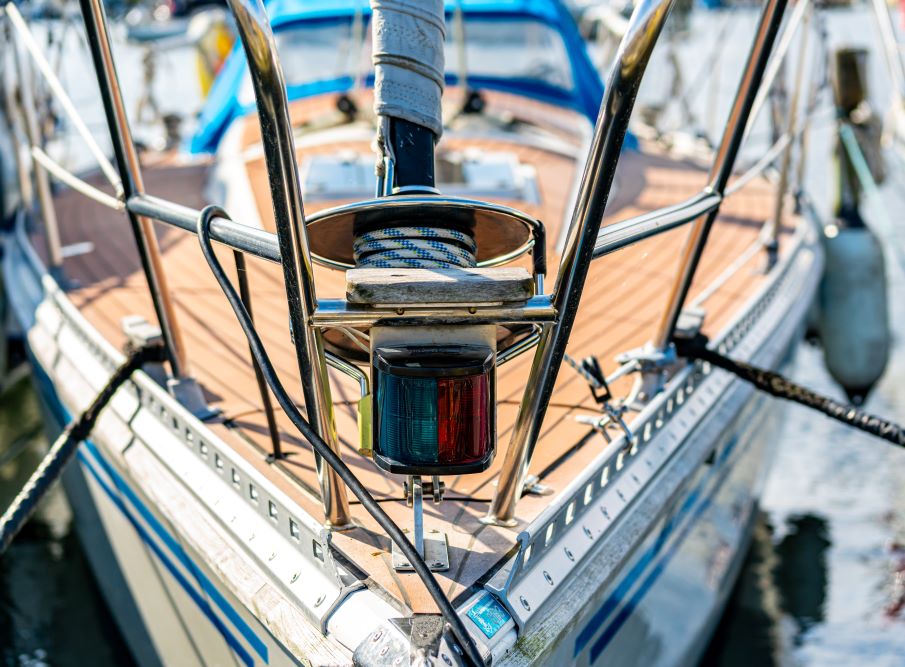
Sidelights can be combined in a single lantern placed at the front tip of the boat’s longitudinal axis.
3. Sternlight
This white light is placed as close as possible to stern, and projects uninterrupted light backward across the horizon in a 135° arc.
4. All-round white light
As its name suggests, this navigation light projects uninterrupted white light across the horizon in a 360° arc. It is usually placed at the stern of the boat.
Other navigation lights
Other navigation lights that are less commonly used by pleasure boaters include:
Towing light
The towing light is a yellow light placed as close to the stern as possible. It projects uninterrupted light backwards across the horizon in a 135° arc.
Flashing light
A regular flashing light flashes at a frequency of 120 or more times per minute.
Special flashing light
A special flashing light is a yellow light that flashes at a lower frequency than a regular flashing light. This navigation light flashes at regular intervals at a frequency of 50 to 70 times per minute. It is placed as close as possible to the front of the tug or boat being towed.
Blue flashing light
The blue flashing light is a blue light that is visible all around the horizon, flashing at regular intervals at a frequency of 50 to 70 times per minute. This type of navigation light is mainly used by boats that belong to the state or police.
If a police boat approaches your vessel with a blue flashing light, you must stop and wait for it to reach you.
When to use navigation lights
Vessels must use their navigation lights when operating in the evening after sunset or early in the morning before sunrise.
Navigation lights must also be used during the day when visibility is restricted or reduced. Fog, heavy rain and snow are examples of conditions that can reduce visibility.
Recognizing different types of vessels based on navigation lights
As mentioned above, when you encounter a boat at night or in reduced visibility, navigation lights can help you identify what type of vessel it is.
Motorboats under 7 metres long
While its speed doesn’t exceed 7 knots, motorboats of this size must at least be equipped with an all-round light.
Motorboats under 12 metres long
While underway, motorboats of this size must display sidelights and an all-round light.
Motorboats over 12 metres long
While underway, motorboats of this size must display sidelights, a masthead light and a sternlight.
Sailboats
While underway, a sailboat must display sidelights and a sternlight. However, if the sailboat is less than 20 metres long, these lights may be combined at the top of the mast.
Sailboats under 7 metres long
Sailboats under 7 metres long may sail without lights, but must be prepared to signal their presence with an electric flashlight or lighted lantern showing a white light. The same rule applies for canoes and kayaks.
Visibility range requirements for navigation lights
Navigation lights must possess a sufficient range of visibility to comply with regulations.
| Vessel Length | Navigation Lights: Range |
| Under 12 metres | 2 miles (except for sidelights, which only need to be visible within 1 mile) |
| Between 12 and 50 metres | 2 miles (except for the masthead light, which must be visible within a 5-mile radius, or for 3 miles for boats under 20 metres) |
The National Boating Safety School safe boating course will prepare you to obtain your Pleasure Craft Operator Card
The National Boating Safety School offers a Transport Canada approved boating safety course that will prepare you for the official online boating exam. Once you pass the test, you will be awarded your lifetime Pleasure Craft Operator Card. Register today!
Frequently Asked Questions
1. What happens if you do not display your navigation lights correctly?
If you don’t use your lights or fail to use the correct lights when the situation requires, you could be fined.
If you fail to comply with navigation light regulations and cause an accident as a result, you could suffer serious legal consequences and be held liable for damages or injury under the civil code.
2. What is the ``stand-on`` rule for navigation lights?
In Canada's Collision Regulations, if you see a green light from another boat, you are generally the "stand-on" vessel, meaning you must maintain your course and speed. If you see a red light, you are the "give-way" vessel, meaning you must take early and substantial action to keep clear. Seeing both a red and a green light indicates a boat is approaching you head-on, and both vessels must turn to starboard (right) to avoid a collision.
3. Do you need to know the difference between port and starboard to interpret navigation lights?
Yes, you absolutely need to know the difference between port and starboard to correctly interpret navigation lights.
The color of a boat's navigation lights directly corresponds to its port and starboard sides, which is essential for determining a vessel's direction and for following the rules of the road. When you see a vessel at night, the combination of its lights tells you what to do.
4. Do navigation lights indicate the bow and stern of a boat?
Yes, navigation lights are designed to show which is the bow (front) and which is the stern (back) of a boat. If you see a red and green light, you are looking at the boat's bow. If you only see a white light, you are looking at the boat's stern. A white masthead light on powerboats also helps indicate the bow, as it shines forward and is placed higher than the sidelights. Check out our article if you need a refresher on the parts of a boat.
Sources
- Transport Canada. SAFE BOATING GUIDE. . https://tc.canada.ca/sites/default/files/2024-03/tp_511e.pdf
- Government of Canada. Collision Regulations (C.R.C., c. 1416) Justice Laws Website. https://laws-lois.justice.gc.ca/eng/regulations/c.r.c.,_c._1416/
Related CONTENT
LAtest ARTICLES