
Magnetic Boat Compass: Your Complete Guide
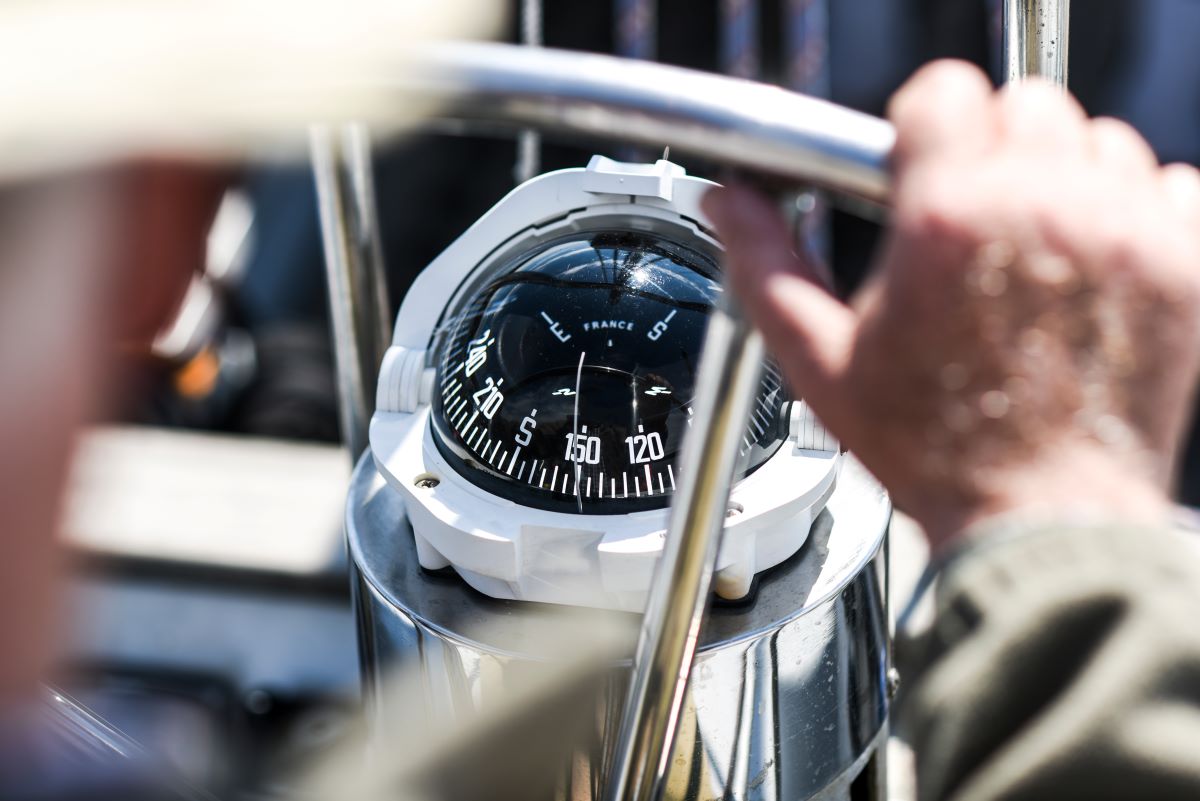
In Canada, Transport Canada regulations mandate that most pleasure craft, with a few exceptions, must be equipped with a standard magnetic compass. It’s an important piece of boating safety equipment that is required on board at all times.
Key takeaways
- To go boating legally in Canada, you need to have a magnetic compass on board.
- Magnetic boat compasses must not rely on any power source to function, be easily visible by the helmsman, be mounted a suitable distance from any metallic equipment that could interfere with the readings, and be equipped with lighting for use in poor visibility or at night.
- To use your boat compass effectively, you must understand declination and deviation and be able to adjust accordingly.
- While many other types of boat compasses exist, including Fluxgate and GPS compasses, these will not meet the requirements for legal boating on Canadian waters.
Table of contents
Magnetic compasses are key to boat navigation
A compass is a navigational tool used on water or land. By displaying the north orientation reference on a horizontal plane, it helps navigators to measure other horizontal angles in degrees, and thus head in the right direction.
A magnetic compass helps directing people by aligning itself with the Earth’s magnetic field to indicate a bearing reference: north. Once you know which direction is north, you can plot or adjust your course accordingly and reliably find your way from A to B.
Magnetic Compass Regulations for Boats in Canada
Canada’s Navigation Safety Regulations state the requirements for any pleasure craft in terms of magnetic compass use. Here is a quick outline of how this applies to most recreational vessels:
Boats that require a magnetic compass
In Canada, a recreational vessel is generally required to have a magnetic compass. The specific requirements can vary based on the size of the vessel and where it is being operated.
A magnetic compass is required for any vessel that is over 8 meters in length, or if a smaller vessel is operated out of sight of navigation marks.
- Exceptions: A magnetic compass is not required if the pleasure craft is 8 meters (26.2 feet) or less in length and is operated within sight of navigation marks (seamarks).
Characteristics of an approved magnetic compass
To meet the standards set out by Transport Canada, your magnetic compass must have the following characteristics:
- The compass must be independent of any power supply and located at the main steering position.
- It must be properly compensated, and a table or curve of residual deviations must be available on board.
- It must be installed and used in a way that minimizes interference from nearby metallic objects, according to the minimum safe distances outlined by the manufacturer.
- It must be capable of functioning correctly under the operational and environmental conditions experienced on board a vessel.
- It must be capable of showing the information on the card (the clear section marked with direction indicators) at any time of day or night, so will require some sort of internal lighting.
- It must be clearly readable by the helmsman at the main steering position.
Using your compass: declination and deviation
When using a magnetic compass, it’s important to distinguish between compass north (can be influenced by nearby metallic objects), magnetic north (seen on maps) and true north (geographic North Pole).
The potential angle shift that can occur between compass north and magnetic north is called deviation. Similarly, the offset between true north and magnetic north is called magnetic declination.
Definition of Declination
Declination is the difference between magnetic north (where a compass points) and true north (geographic north). The Earth's magnetic field is not perfectly aligned with its geographic poles, and the magnetic field varies by location and changes over time. Declination must be accounted for when navigating with a compass to determine true north.
Definition of Deviation
Deviation is the error in compass readings caused by local magnetic fields from the vehicle or nearby objects (like metal in a ship or aircraft). Deviation can be significant and must be accounted for to get accurate compass readings. Deviation is usually corrected by using a compass deviation card, which provides specific error corrections for different compass headings.
In higher latitudes, the horizontal component of the Earth's magnetic field, which is what a magnetic compass relies on, becomes very weak or distorted. This can cause the compass to fluctuate erratically and provide inaccurate readings. Deviation is a serious concern when using a magnetic compass in northern areas of Canada, such as the Northwest Territories, Nunavut or the Yukon.
Standard Compass versus Steering Compass
A standard compass and a steering compass, both magnetic compasses used in maritime navigation, differ primarily in their purpose and placement.
Standard Compass
This is the type of compass that is required on most pleasure craft. It is used for navigation, especially when sailing at a certain distance from shore.
Steering Compass
A steering magnetic compass can be used instead of a standard compass on vessels under 150 tons, or vessels under 500 tons not engaged on international voyages or voyages beyond certain limits, according to Canadian regulations. It is not a safety requirement.
Fluxgate and GPS compasses
Under Canada's Navigation Safety Regulations a recreational vessel that is required to have a compass must be fitted with a standard magnetic compass that is independent of any power supply. This is a critical requirement to ensure that a basic form of navigation is always available, even in the event of a power failure.
While fluxgate and GPS compasses are excellent tools for navigation, they are considered to be powered navigation equipment. A GPS compass, in particular, provides heading information by using multiple GPS antennas to calculate the vessel's orientation. A fluxgate compass, although it uses the Earth's magnetic field, requires a power source to operate its electronic sensors and display.
Therefore, while you can and many boaters do use a fluxgate or GPS compass as a primary source of navigation, they do not fulfill the legal requirement for the mandatory magnetic compass because they are not independent of a power supply. The regulations specify the need for a non-powered, magnetic compass as a fundamental safety device.
Other types of boat compass
In addition to the magnetic compass, there are other navigational devices that can also indicate north. Here’s an overview of the different types of boat compasses and their specific features.
Gyroscopic compass
Unlike the magnetic compass (which shows compass north), the gyroscopic compass shows true north (geographic North Pole) and requires a power supply to work. Unlike traditional magnetic compasses, gyroscopic compasses are not affected by changes in the earth’s magnetic field.
Electric compass
The electric compass, just like the gyroscopic compass, needs a power supply to work. However in other ways, it is similar to a magnetic compass. It identifies the magnetic field by interacting with the electrical properties of certain materials that are exposed to it. In order to do this, the electric compass uses different technological strategies such as a fluxgate sensor, the Hall effect, magneto resistivity and magneto induction.
Satellite compass
A satellite compass is a navigational device that uses satellite signals to work out which direction a boat should follow. The satellite compass system is made up of two satellite antennas generally positioned at the front and back of the boat that are each connected to GPS receivers. The whole thing is then connected to a computer.
The navigational information is received by the satellites, then it is sent and picked up by the GPS receivers. Once this happens, the computer indicates the route to follow by calculating the slightly staggered data from the two receivers.
The National Boating Safety School safe boating course will prepare you to obtain your Pleasure Craft Operator Card
The National Boating Safety School offers a Transport Canada approved boating safety course that will prepare you for the official online boating exam. Once you pass the test, you will be awarded your lifetime Pleasure Craft Operator Card. Register today!
Frequently Asked Questions
1. Can I just use my GPS or phone instead of a compass?
No. While GPS and electronic navigation systems are invaluable tools, they are not a substitute for the mandatory magnetic compass. The regulations specifically require a compass that is independent of any power supply. The purpose is to ensure that you have a reliable way to navigate if your vessel loses all electrical power.
2. What is the difference between magnetic north and true north?
This is a core concept in navigation.
- True North: The geographic North Pole, a fixed point on the Earth's surface.
- Magnetic North: The location of the Earth's magnetic North Pole, which is constantly shifting. The difference between the two is called variation (or declination) and it's a value you must account for when plotting a course using a magnetic compass. This value is printed on nautical charts and changes depending on your location.
3. Why does my compass seem to be pointing in the wrong direction?
If your compass seems to be pointing tin the wrong direction, it is most likely due to variation (The natural difference between true north and magnetic north) or deviation (error caused by the magnetism of your boat itself, including engines, wiring, steel components, and even magnetic items you have on board like speakers or tools.
4. How do I properly install a boat compass?
Proper installation is key to accuracy. A compass should be mounted on the boat's centerline, away from any sources of magnetic interference.
5. What do I need to know about magnetic compass maintenance?
- Getting rid of a bubble in the fluid: Compass fluid can contract in the cold, causing a bubble to form. While a small bubble is not a major issue, a large one can affect the compass card's movement. This requires a professional repair job.
- Fixing a “Sticky” compass: Has your compass card stopped rotating freely? This could be due to a worn pivot and may also require professional repair.
- Protecting a compass from the sun: Sun exposure can cause the dome to become cloudy or the fluid to degrade. Use a proper compass cover from the manufacturer to prevent wear and tear.
Sources
- Transport Canada. STANDARDS FOR NAVIGATING APPLIANCES AND EQUIPMENT. . https://tc.canada.ca/sites/default/files/migrated/tp3668e.pdf
- Government of Canada Navigation Safety Regulations SOR/2005-134. Justice Laws Website. https://laws-lois.justice.gc.ca/eng/regulations/sor-2005-134/20060322/P1TT3xt3.html
- Government of Canada Navigation Safety Regulations SOR/2020-216. Justice Laws Website. https://laws-lois.justice.gc.ca/eng/regulations/SOR-2020-216/FullText.html
- Government of Canada Earth’s Magnetic Field.https://geomag.nrcan.gc.ca/mag_fld/magdec-en.php
Related CONTENT
LAtest ARTICLES