
Canadian Regulations for Reboarding Devices
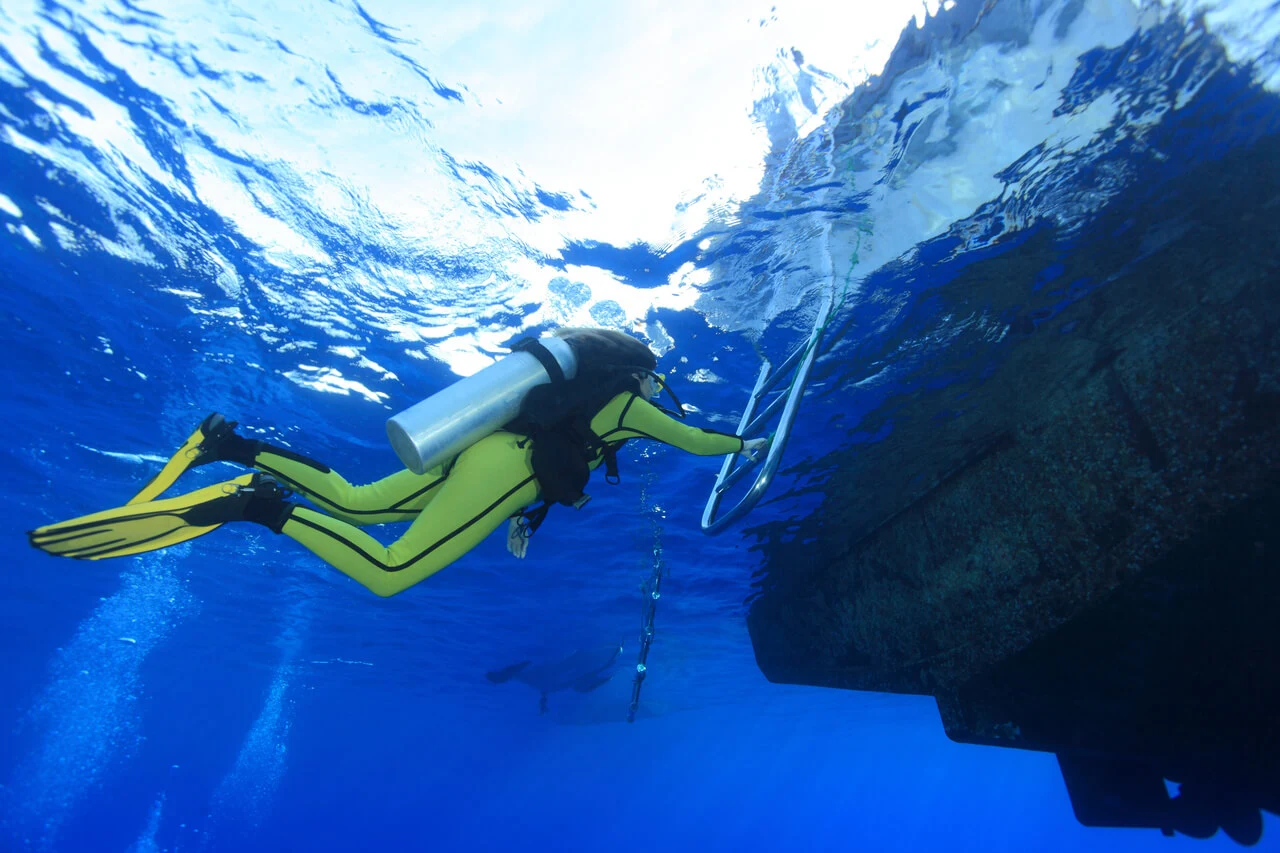
A reboarding device is a crucial piece of safety equipment designed to help a person who has fallen into the water get back onto the boat. They are especially important if someone is boating alone or if the boat's freeboard (the distance from the water to the gunwale) is high.
Key takeaways
- Reboarding devices are a required pieces of boating safety equipment on any pleasure craft in which the freeboard is more than 0.5 meters.
- Reboarding devices save lives by making it possible to climb back into a boat.
- Acceptable reboarding devices include buoyant heaving lines, fixed transom ladders, rope ladders, and lifting harnesses.
- Reboarding devices must always be stored in a location that is easily accessible by a person in the water.
Table of contents
- Reboarding Devices are required safety equipment
- What is a reboarding device?
- Types of reboarding devices
- Built-in transom ladder
- Buoyant heaving line
- Ladder
- Lifting harness
- Where to store your reboarding device
- Frequently Asked Questions
Reboarding Devices are required safety equipment
Under Transport Canada's Small Vessel Regulations, a reboarding device is a required piece of safety equipment if the vertical height that must be climbed to reboard your vessel from the water (the “freeboard”) is more than 0.5 meters (1 foot 8 inches).
What is a reboarding device?
A reboarding device is a safety device. It is located at the stern of a pleasure craft. It can be a platform, a ladder or even a rope. It is a simple but potentially life-saving tool that ensures anyone who falls overboard can get back on board safely and without assistance.
Purpose of a reboarding device
The reboarding device can be used in a variety of ways. While it can help swimmers and divers get down into the water more easily, it is usually used to help people get back into the boat.
Types of reboarding devices
There are four main types of reboarding devices. Different reboarding devices are suited to different types of boats. The type of device you choose must safely allow a person to get back on board from the water.
Important: Canadian regulations state that the reboarding device cannot include any part of the vessel's propulsion unit. This means you cannot use the motor or propeller as a step or a handhold.
1. Built-in transom ladder
The ladder must be designed to allow you to easily climb out of the water and back onto the vessel. The propulsion unit (motor) of the boat cannot be used as a reboarding device.
2. Buoyant heaving line
A buoyant heaving line is considered a reboarding device. These are the requirements:
- The rope must float
- The rope must be long enough to reach into the water (at least 15 metres)
- The rope must be tied to the boat
- The rope must be one sold rope, not multiple ropes tied together
3. Ladder
There are two types of ladders for boats:
Skewed ladders (rope or webbed ladders) are folding ladders that are located at the back of the boat. When navigating, they are folded up so as not to disturb the engine propellers. However, when on the water, they can be unfolded for a swim or to be used to get back on the boat. It is important that they go down deep enough into the water to facilitate the ascent and descent of passengers.
Swim platform ladders are ladders that are built directly onto the boat’s platform at the back. Also collapsible, they are put in the water when swimming and make it easier to get into the boat when going up.
4. Lifting harness
Lifting harnesses are reboarding devices that are intended for sailboats or boats longer than 24 meters in length. The lifting harness has two components: a pulley type mechanism and a harness. The harness is often integrated into a life jacket.
The principle is simple: a lanyard equipped with a carabiner connects the harness of the life jacket to the boat. If a person falls in the water, they can easily attach their lanyard to the carabiner when thrown towards them. The lift recoils the line, and the person can easily reboard the boat safely.
Where to store your reboarding device
Like all safety equipment, the reboarding device must be readily accessible to all passengers in an emergency. If it's a portable device, it must be stored in a place where a person in the water can reach it, deploy it, and secure it. It should not be stowed in a locker where it would be impossible to reach.
The National Boating Safety School safe boating course will prepare you to obtain your Pleasure Craft Operator Card
The National Boating Safety School offers a Transport Canada approved boating safety course that will prepare you for the official online boating exam. Once you pass the test, you will be awarded your lifetime Pleasure Craft Operator Card. Register today!
Frequently Asked Questions
1. Is a reboarding device required on all boats in Canada?
No. A reboarding device is only required under Transport Canada's Small Vessel Regulations if the boat's freeboard—the vertical height a person has to climb to get back on board—is more than 0.5 meters (1 foot 8 inches). If your boat's side is low enough that someone can easily climb back in without a device, one is not legally required, though it is still a good safety measure to have.
2. Can I use the boat's engine or propeller to help me reboard?
No, the regulations explicitly state that a reboarding device cannot include any part of the vessel's propulsion unit. This is a critical safety rule, as using the engine or propeller to climb could lead to a serious or fatal injury if the motor is accidentally engaged.
3. Why is a reboarding device so important, even for strong swimmers?
Even a strong swimmer can become exhausted quickly in cold water. Hypothermia, cold water shock, and fatigue can make it impossible to pull oneself back into a boat, especially one with a high side. A reboarding device provides the leverage and assistance needed to get back on board before these conditions become a threat to life.
Sources
- Government of Canada. Small Vessel Regulations (SOR/2010-91). Justice Laws Website. https://laws-lois.justice.gc.ca/eng/regulations/SOR-2010-91/section-310.html
Related CONTENT
LAtest ARTICLES