Upstream vs. Downstream : Understanding the Difference
It’s important to know the difference between upstream and downstream so you can correctly interpret buoys and avoid collisions on Canadian waterways.
Key takeaways
- Upstream and downstream are terms that indicate the flow of the current in a river.
- Upstream refers to water flowing toward its source, typically inland.
- Downstream refers to water flowing away from its source, typically toward the sea.
- Understanding these terms is important, as boaters can then indicate clearly the direction in which they are traveling and interpret lateral buoys (port hand buoys and starboard hand buoys) accordingly.
Table of contents
What’s the difference between upstream and downstream?
Upstream and downstream describe the directional flow of the water in a river. The terms are used to indicate which direction a vessel is travelling, indicating whether they are moving with or against the current. Aids to navigation will be interpreted accordingly.
Upstream definition
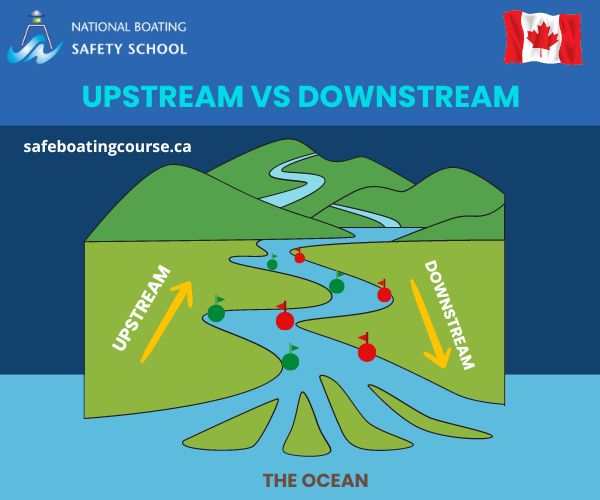
When you are going upstream, you are moving towards the source of the water, typically inland from the sea.
How can you tell which way is upstream when you’re out on a river?
- When going upstream, you’re moving against the current. If your boat feels like it’s fighting the natural flow, you’re likely going upstream.
- If entering a waterway from the sea, you’re going upstream.
- Water often flows north to south, so if you’re heading north, you’re likely traveling upstream.
Downstream definition
When you are going downstream, you are moving away from the source of the water, typically towards the sea.
How can you tell which way is downstream when you’re out on a river?
- When going downstream, you’re moving in the same direction as the current. If your boat is moving without any source of mechanical or human propulsion, you’re likely going downstream.
- If moving along a waterway toward the sea, you’re going downstream.
- Water often flows north to south, so if you’re heading south, you’re likely traveling downstream.
Marine charts indicate upstream and downstream
The most reliable method for knowing which way the current is flowing, and which way you are travelling, is to consult a marine chart. Always take up-to-date marine charts with you when river boating!
Using upstream and downstream to interpret lateral buoys
Boaters need to know the difference between upstream and downstream to follow lateral buoys and stay on the right side of a channel.
There are two types of buoys that indicate which way to go when heading upstream:
What are port hand buoys?
Port hand buoys are green. They should be on your port (left) side when heading upstream.
What are starboard hand buoys?
Starboard-hand buoys are red. Keep red lateral buoys on your starboard (right) side when heading upstream.
The National Boating Safety School safe boating course will prepare you to obtain your Pleasure Craft Operator Card
The National Boating Safety School offers a Transport Canada approved boating safety course that will prepare you for the official online boating exam. Once you pass the test, you will be awarded your lifetime Pleasure Craft Operator Card. Register today!
Frequently Asked Questions
1. Do upstream and downstream affect steering?
The current is the most powerful force on a river. When traveling downstream, the current is working with you, which can make the boat faster and harder to stop or steer. You need to use less power and be more attentive to your course.
When going upstream, the current is working against you. This requires more engine power to make progress and gives you more control over the vessel's speed and direction, which can be useful when navigating through tight spaces or around obstacles.
2. How do upstream and downstream impact boating safety?
If someone falls overboard, they will immediately be carried downstream by the current. A boater who understands this instinctively knows they must turn their vessel and head downstream to reach the person as quickly as possible.
The river current can carry floating debris (logs, branches, etc.) downstream. Boaters traveling upstream must be more vigilant in spotting these hazards as they are heading directly towards them.
3. Do upstream and downstream play a role when anchoring a boat?
Anchoring should always be done from the bow (front) of the boat, and the anchor should be dropped upstream of your intended position. This allows the current to push the boat back over the anchor line, securing the vessel and preventing it from being pulled away by the force of the water.
4. What is the impact of upstream and downstream on fuel consumption?
Traveling downstream is far more fuel-efficient as the current is doing much of the work for you. Traveling upstream requires more engine power, and thus burns more fuel (or battery power). Understanding this helps boaters plan their trips and refuel stops accordingly.
5. What do upstream and downstream have to do with passing and right of way?
In many jurisdictions, the general rule of the road for vessels is that the boat traveling upstream against the current has more difficulty maneuvering. Therefore, it is often given the right of way by a vessel traveling downstream. This is a common-sense courtesy that helps prevent collisions.
Sources
- Transport Canada. SAFE BOATING GUIDE. . https://tc.canada.ca/sites/default/files/2024-03/tp_511e.pdf
- Government of Canada. TP 14541 – Lateral Buoys and Standard Daybeacons (2022) Transport Canada. https://www.tc.canada.ca/en/marine-transportation/publications/tp-14541-lateral-buoys-standard-daybeacons-2022
Related CONTENT
LAtest ARTICLES